Air Compressors · 2026 edition
The Quietest Air Compressors That Actually Deliver (2026)
Every quiet air compressor listing on Amazon claims 60 dB. Turn it on in your garage and suddenly you're shouting over it. There's no industry standard for how manufacturers measure compressor noise — no required distance, no required load. That "60 dB" could mean anything.
Scoring draws on manufacturer specs (with that duty-cycle caveat baked in), independent workshop testing, contractor and woodworking forum data, and verified buyer feedback. Below are the ten that earned their spot, from a 30 dB unit you genuinely cannot hear running to an 81 dB shop compressor that's still quieter than anything at your local hardware store.
4 Things You've Been Told Wrong About Quiet Compressors
Before the product roundup, let's correct the record.
"60 dB is whisper quiet"
It's not. 60 dB is a normal conversation. A running dishwasher. Buyers who get a 60 dB compressor describe it as "surprisingly quiet" and "I can talk over it" — not "I can't hear it." True near-silence starts around 30 dB. Set real expectations: 60 dB is good. It is not silent.
"Oil-free means quieter"
Usually the opposite. Oil-free dominates because buyers avoid oil changes. But the oil film in a lubricated compressor dampens the mechanical clatter between moving parts. The quietest compressor in this roundup (30 dB) is oil-lubricated. Most "ultra-quiet" oil-free units hit 60 dB. Still good, but not in the same league.
"Bigger tank = louder compressor"
The motor is the noise source, not the tank. A bigger tank doesn't make the motor louder — it just means the motor cycles less often. A 13-gallon compressor running twice an hour is less annoying than a 1-gallon compressor running every 90 seconds, even at identical peak dB. Think about total noise exposure, not just peak levels.
"All quiet compressor lists recommend the same stuff"
They do. And it's not a conspiracy: California Air Tools genuinely owns this segment. Their 1680 RPM motor design (versus the 3450 RPM standard) is why. Lower RPM means less vibration means less noise. Other brands hitting 60 dB use better mufflers or enclosures. But the low-RPM engineering is why CAT appears on every list, including ours.
All 10 Compressors at a Glance
Sorted by dB, quietest first. Tank size is the quick filter for use case.
| Product | dB | Tank | Price | Badge | Verdict |
|---|---|---|---|---|---|
| Silentaire Super Silent 20 | 30 dB | 0.4 gal | $655 | Quietest Overall | Studio-grade silence, airbrush only |
| California Air Tools CAT | 56 dB | 1 gal | $149 | Quietest Oil-Free | Quietest oil-free, light-duty winner |
| California Air Tools 8010 1.0 HP Ultra Quiet and Oil | 60 dB | 8 gal | $199 | Best Value | Best all-around value |
| California Air Tools CAT | 60 dB | 4.6 gal | $290 | Compact twin-tank, portable | |
| Air Compressor | 60 dB | 1 gal | $130 | Fastest Recovery | Fastest recovery (13 seconds) |
| Stealth Air Compressor 2 Gallon | 60 dB | 2 gal | $190 | Solid tire-inflation pick | |
| VEVOR 13 | 66 dB | 13 gal | $221 | Best Big Tank | Best big-tank value |
| California Air Tools 10020C 2.0 HP Ultra Quiet and Oil | 70 dB | 10 gal | $399 | Workhorse with durability caveats | |
| TC·BL Portable Air Compressor 110V | 75 dB | Tankless | $189 | Tankless novelty, mixed reliability | |
| Klutch 29 | 81 dB | 29 gal | $300 | Max capacity, ear protection needed |
Studio Silent (Under 40 dB)
You will pay for this level of quiet. In money, in tank size, and in tool compatibility. For the right buyer — airbrush artists, dental tech setups, recording studios — it's worth every dollar.
Quietest Overall Silentaire Super Silent 20-a
30 dB oil-lubricated. Airbrush and precision work. Nothing else is close.
Silentaire Super Silent 20-a
30 dB oil-lubricated. Airbrush and precision work. Nothing else is close.
One buyer keeps a sticky note near their workbench reminding them to turn it off, because they literally cannot tell it's running.
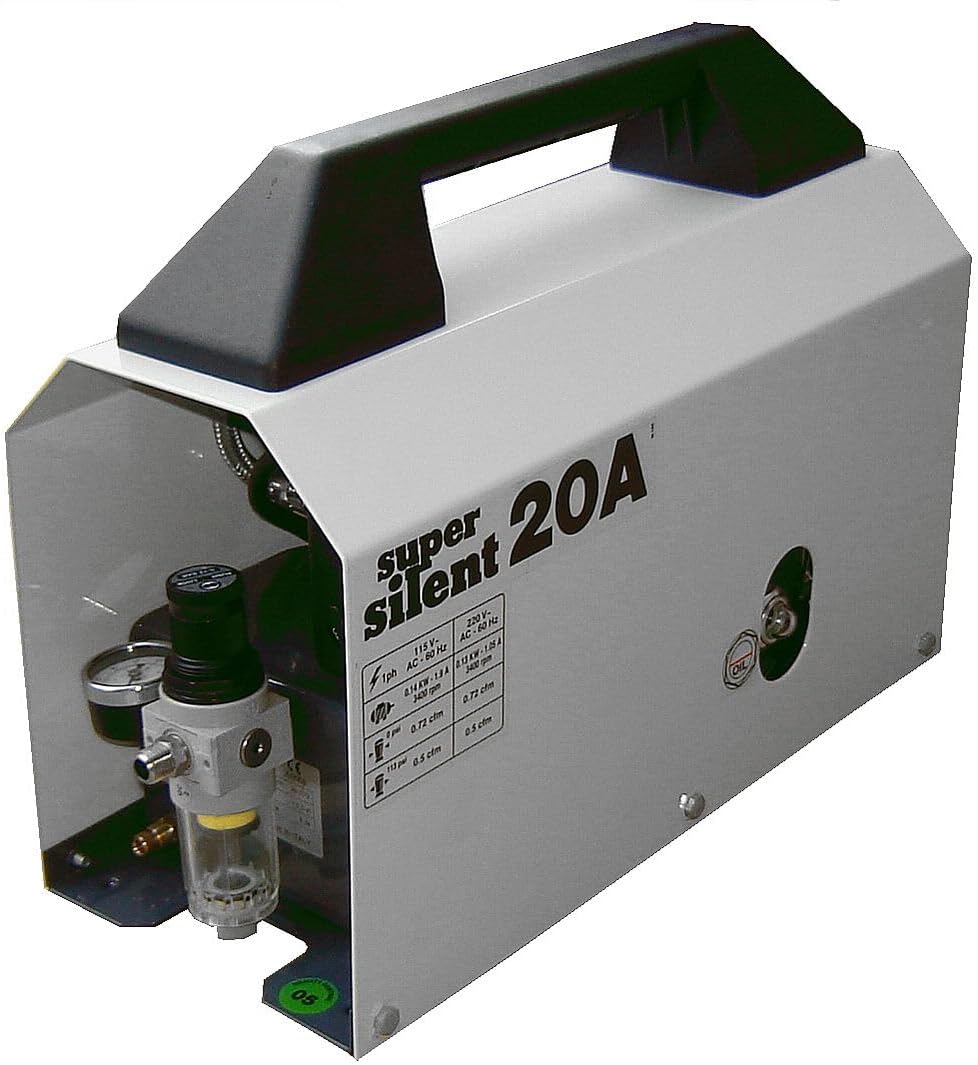
30 dB from a compressor. That's not a typo. It's quieter than your refrigerator's hum. One buyer keeps a sticky note near their workbench reminding them to turn it off, because they literally cannot tell it's running. Another switched from an oil-free Grex and described the noise difference as shocking.
This is oil-lubricated, and that's exactly why it achieves 30 dB. The oil film between pistons and cylinders absorbs the mechanical clatter that makes every other compressor loud. You pay for this in two ways: the $655 price tag, and the 40-minute oil fill on initial setup. After that, occasional oil checks are the only maintenance.
Know what you're buying. 0.7 CFM at 90 PSI. This runs airbrushes, dental tools, and precision instruments. It will not power nail guns. It will not inflate tires quickly. The 0.4-gallon tank is smaller than a water bottle. For the buyer who needs true silence for precision work, nothing else comes close. For everyone else, keep scrolling.
Also worth knowing: the Silentaire DR-150 ($799) exists for buyers who need 114 PSI instead of 85 PSI. Same 30 dB noise level, higher pressure ceiling.
We earn a commission on purchases via these links. It does not change the price you pay or our ranking.
Workshop Quiet (56-60 dB)
This is where most buyers belong. 60 dB is conversation volume. You can talk on the phone. Your dog won't leave the room. California Air Tools dominates here because they figured out something the rest of the industry mostly hasn't: slow the motor down.
Quietest Oil-Free California Air Tools 1P1060SP
Quietest oil-free in the set at $149. The entry point to quiet compressors.
California Air Tools 1P1060SP
Quietest oil-free in the set at $149. The entry point to quiet compressors.
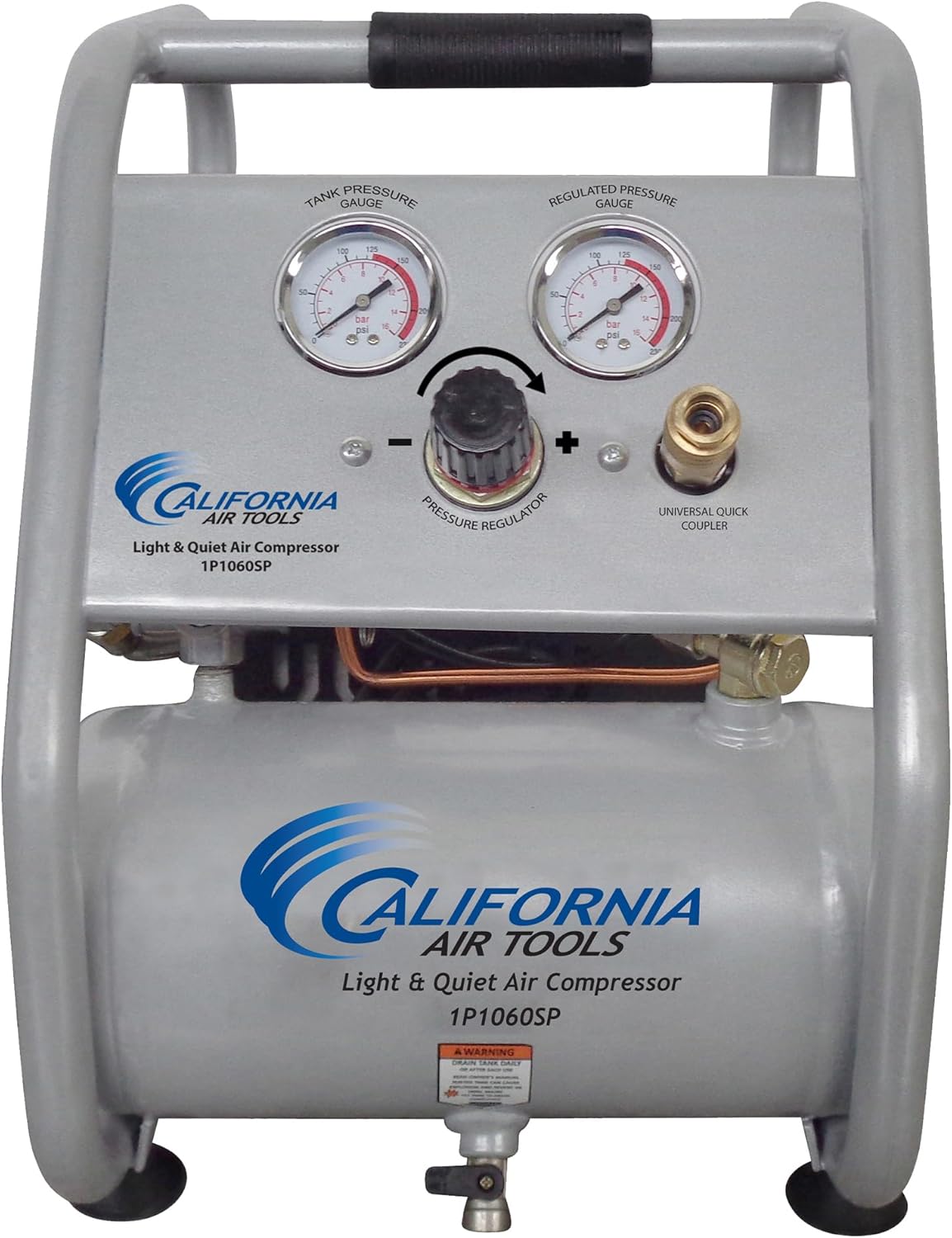
56 dB. Four decibels below the rest of the oil-free pack, which on a logarithmic scale is actually noticeable. Buyers call it "almost inaudible" and "vibration free." One upgraded from a standard piston compressor and called his old one a waste of time. Another keeps it in the back of a truck and uses it on job sites.
At $149 it's the entry point to the quiet compressor world. Oil-free means no maintenance. 34 lbs means it goes anywhere. The honest caveats: a 1-gallon tank cycles frequently under sustained use, and 0.6 HP won't run framing nailers. Durability also has question marks after heavy use. For light-duty work and anyone who just wants quiet, this is the right starting point.
We earn a commission on purchases via these links. It does not change the price you pay or our ranking.
Best Value California Air Tools 8010
8 gallons at 60 dB for $199. The pick most readers should stop at.
California Air Tools 8010
8 gallons at 60 dB for $199. The pick most readers should stop at.
Third-party testing has clocked the 8010 at around 50.6 dB, several decibels below CAT's own 60 dB claim.
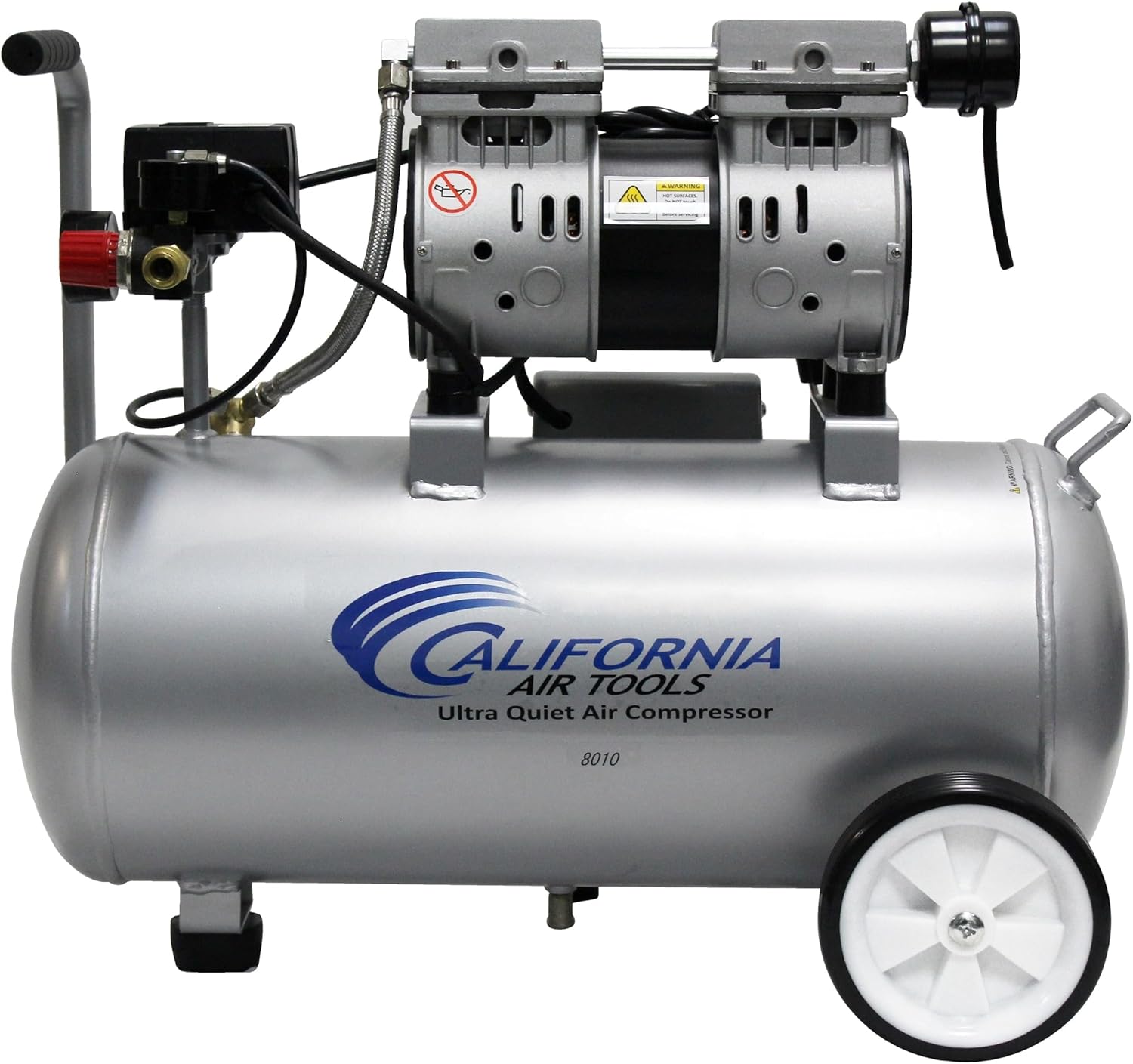
Most readers should stop here. 8 gallons at 60 dB for $199. Dual piston, wheeled, 48 lbs. This is the compressor that made California Air Tools famous.
The spec sheet actually undersells it. Third-party testing has clocked the 8010 at around 50.6 dB, several decibels below CAT's own 60 dB claim. Buyers who run HVLP spray guns confirm it keeps up. One person who owned a Hitachi for 15 years switched to this and was happy — people who replace a known-good compressor don't do it lightly. A full tank fill takes 165 seconds. Recovery from 90 to 120 PSI takes about 60 seconds.
One honest caveat: durability is mixed. Some owners report failures after 6 months of light use. At $199, that's not acceptable. Drain the steel tank after each use or it will corrode. The aluminum 8010A version ($250) shaves 11 lbs if you move it regularly. For stationary garage use, the steel 8010 is the one to get.
We earn a commission on purchases via these links. It does not change the price you pay or our ranking.
California Air Tools 4610AC
Same 60 dB as the 8010 in a compact twin-tank for $91 more.
California Air Tools 4610AC
Same 60 dB as the 8010 in a compact twin-tank for $91 more.
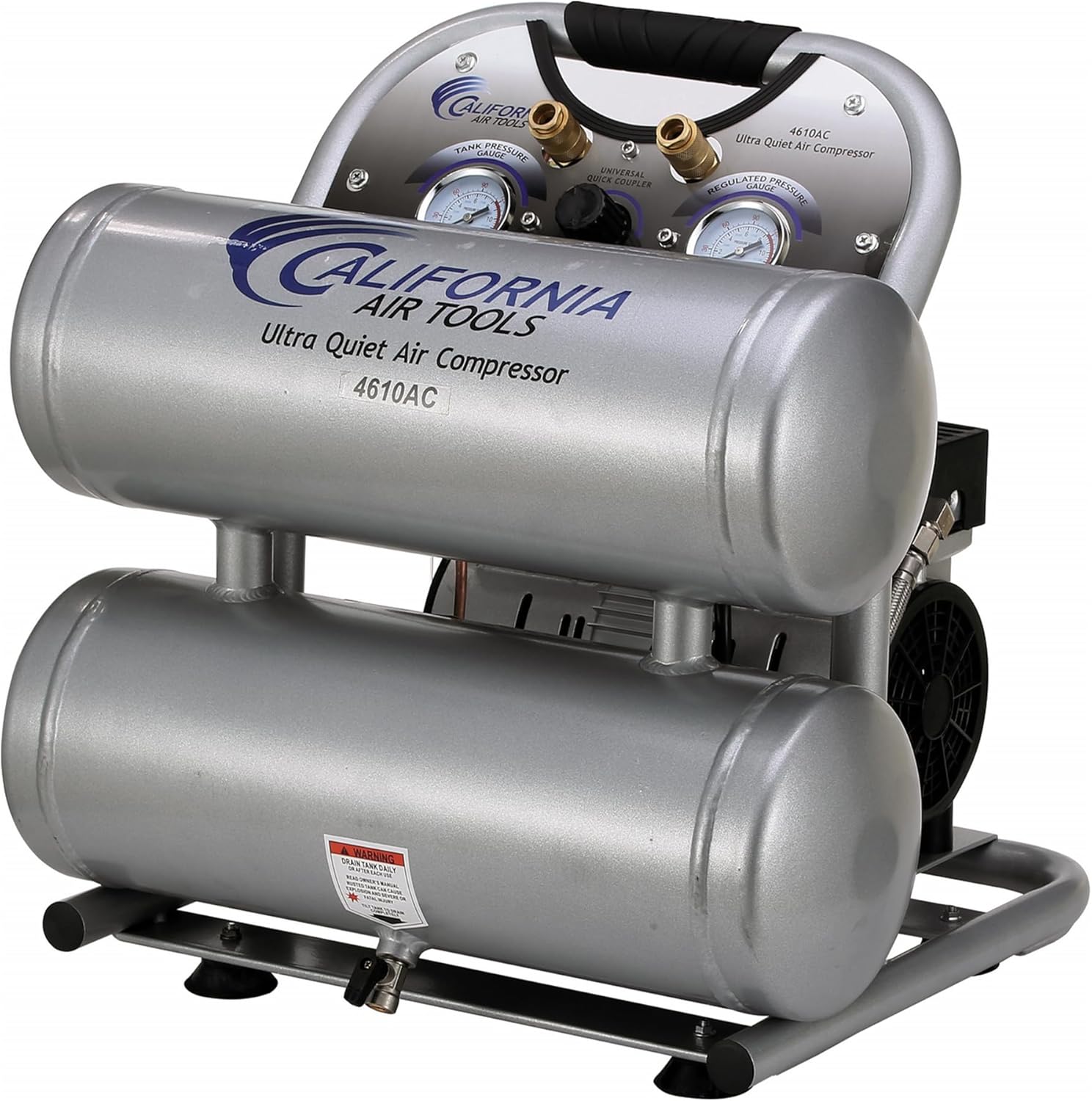
Same 60 dB, same 1680 RPM motor, same dual piston as the 8010. The difference is form factor. Aluminum twin-tank design, 44 lbs, compact footprint. Buyers describe the build as "beefy" and easy to move around a garage. It's the same performance in a smaller, lighter package.
The math is harder to ignore: $290 versus the 8010's $199, for 3.4 fewer gallons of tank. You're paying $91 for compactness. The same reliability concerns apply. If portability is the priority, this makes sense. If you're stationary, the 8010 is the obvious choice and you keep $91.
We earn a commission on purchases via these links. It does not change the price you pay or our ranking.
Fastest Recovery Greteefor 1-Gallon
Fastest recovery in the set (13 seconds) - from a brand with no track record.
Greteefor 1-Gallon
Fastest recovery in the set (13 seconds) - from a brand with no track record.
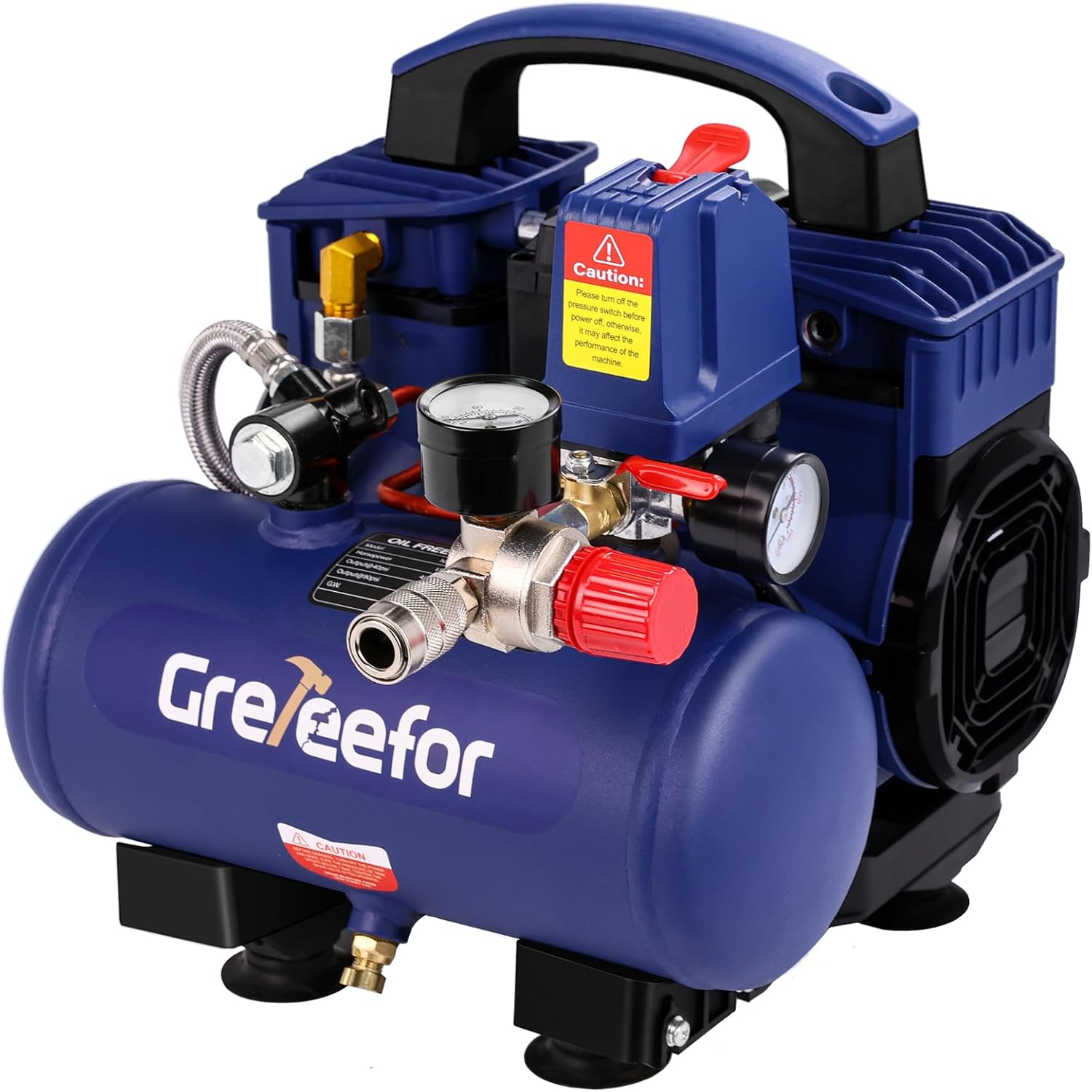
The recovery speed is the whole story. 13 seconds to fill from zero. 4-second recovery after pressure drops. Those numbers are unusual for any small compressor. A 4-pole motor and 1.5 HP peak power get you there. Buyers confirm: "Recovers quickly after a pressure drop and is also very quiet." 23.7 lbs.
$130 from a brand you can't find on Consumer Reports. That's the gamble. California Air Tools has a track record. Greteefor doesn't, at least not yet. The specs are impressive and the buyer feedback is positive, but long-term reliability is genuinely unknown. If you need fast recovery at the lowest price and accept the brand risk, this is an interesting pick. Buy with eyes open.
We earn a commission on purchases via these links. It does not change the price you pay or our ranking.
Stealth SAQ-1234
2-gallon tire-and-light-nailing pick. 1000-hour pump life is the catch.
Stealth SAQ-1234
2-gallon tire-and-light-nailing pick. 1000-hour pump life is the catch.
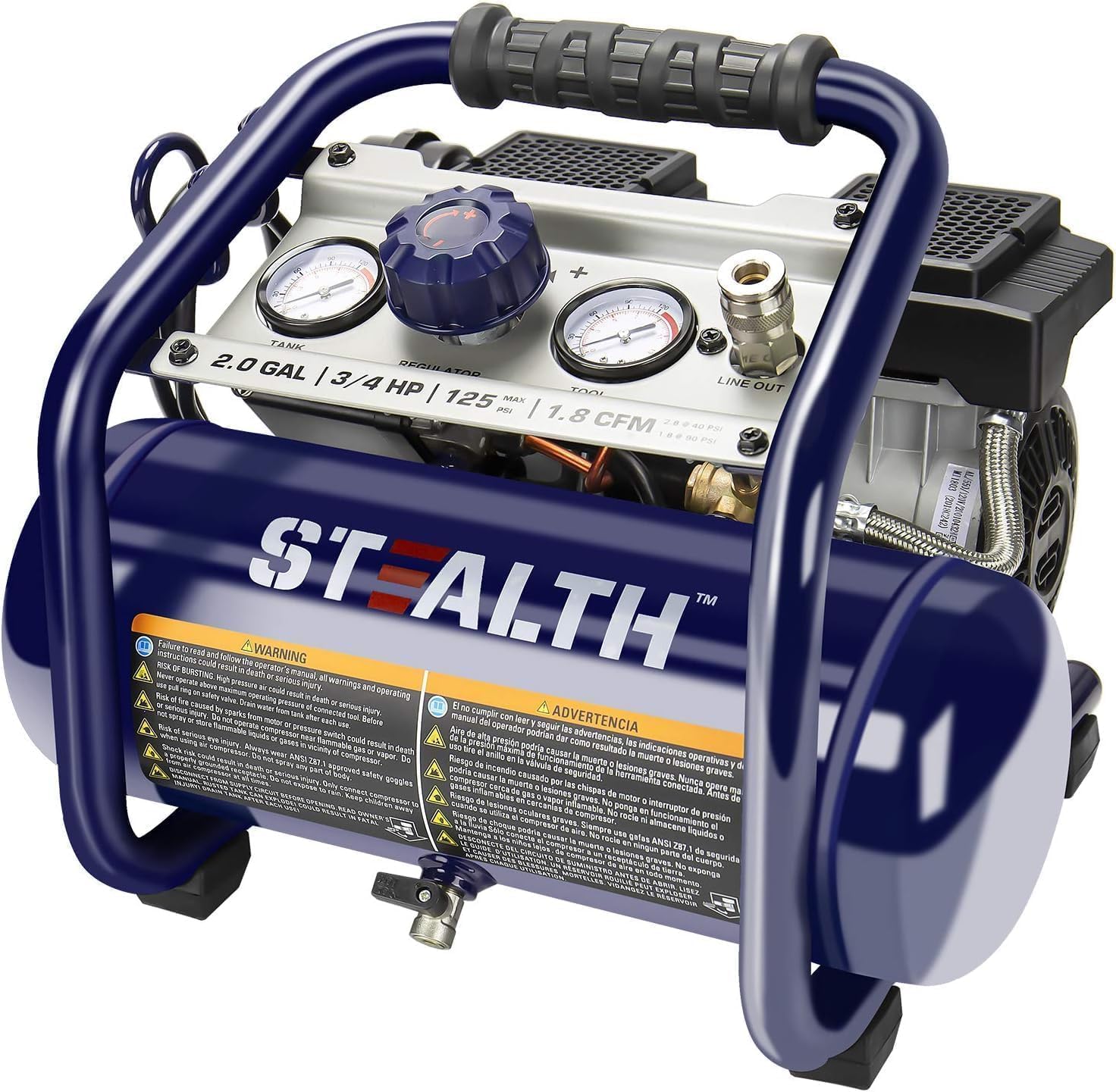
The 2-gallon option. More capacity than a 1-gallon unit, less footprint than an 8-gallon. At 60 dB and 125 PSI max, it fills truck and fifth-wheel tires, handles light nailing, and works for home auto maintenance. One buyer used it to replace a 20-year-old compressor and was happy with the quiet improvement. Quick pressure build-up gets consistent praise.
One number matters for regular users: 1000-hour pump life versus California Air Tools' 3000 hours. That's a real difference for anyone who uses a compressor weekly. Weight draws comments too ("manageable by an average man," as one buyer put it, noting his wife couldn't pick it up). Solid choice for infrequent use. Think twice if the compressor will run every day.
We earn a commission on purchases via these links. It does not change the price you pay or our ranking.
Bigger Tanks, More Noise (66-81 dB)
You need real capacity: spray painting, impact wrenches, continuous heavy use. These are still substantially quieter than the 85-90 dB pancake compressors they replace. But 'quieter than average' is not the same as 'quiet.'
Best Big Tank VEVOR 13-Gallon
13 gallons for $221 that runs real tools. Check your circuit first.
VEVOR 13-Gallon
13 gallons for $221 that runs real tools. Check your circuit first.
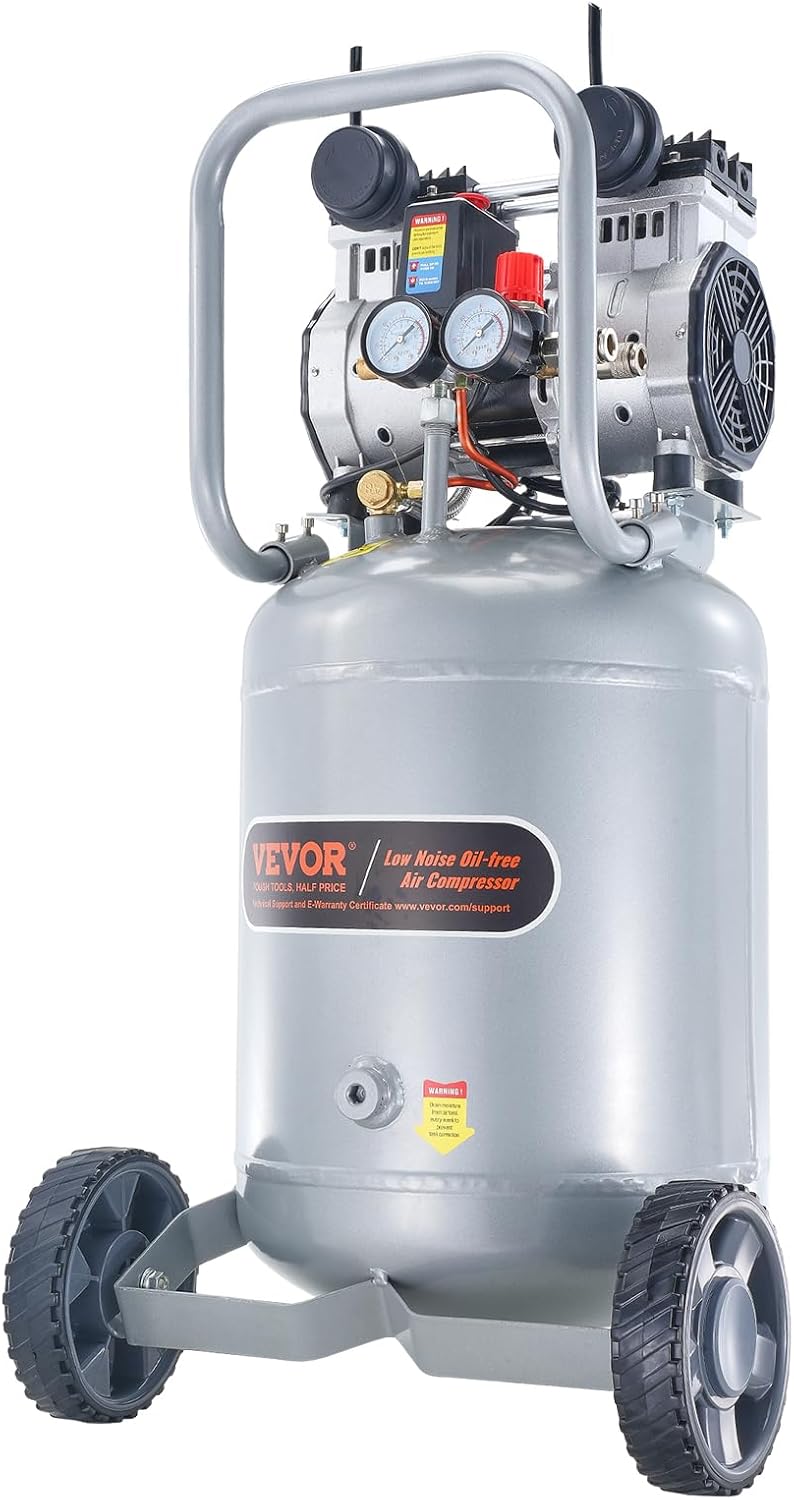
13 gallons for $221. That's the headline. For context, the 10-gallon CAT costs $399. This VEVOR runs real tools: spray guns, impact wrenches, not just brad nailers. 66 dB means you'll hear it, but you won't reach for ear protection. It's "loud conversation" territory, not "turn it off or lose your hearing" territory. Buyers consistently describe it as quieter than they expected from a 13-gallon unit.
Practical highlights: fills a full tank in under 3 minutes, reinforced rubber wheels for moving it around, and one buyer cleared entire lawn irrigation lines with it.
Real warnings before you order: check your electrical. Multiple buyers note the high power draw will trip wimpy circuits, and extension cords cause problems. Assembly instructions are reportedly missing or inadequate. Some units arrive damaged. The price/performance/noise ratio is legitimately great; the buying experience can be rough around the edges.
We earn a commission on purchases via these links. It does not change the price you pay or our ranking.
California Air Tools 10020C
2 HP, 10 gallons, and tank-weld failure reports at $399.
California Air Tools 10020C
2 HP, 10 gallons, and tank-weld failure reports at $399.
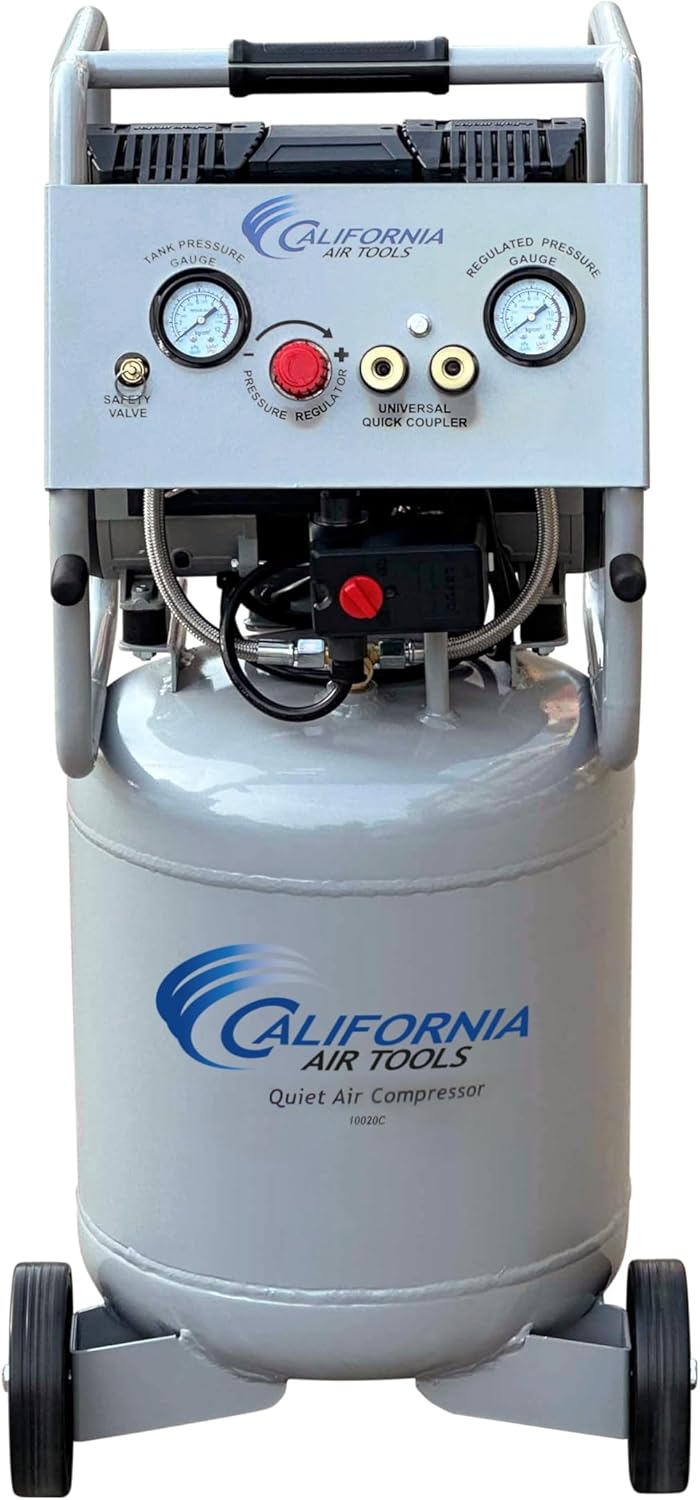
2 HP, 5.3 CFM at 90 PSI, 10 gallons. Buyers confirm it can maintain 60 PSI indefinitely, and quality of construction gets consistent praise. At 70 dB you're clearly louder than the 60 dB family members, right at the edge where residential noise ordinances start becoming relevant. That's the noise picture.
Now the problem. Multiple buyers report tank failures at the weld. Constant air leak reports. Several units stopped working within a month. From a $399 California Air Tools compressor, that is alarming. The brand reputation was built on the 1680 RPM motor concept; the 10020C's durability record suggests that concept doesn't automatically transfer to the larger, more powerful units. Proceed with caution. If you need this capacity tier, the VEVOR 13-gallon at $221 has fewer durability flags despite being a lesser-known brand.
We earn a commission on purchases via these links. It does not change the price you pay or our ranking.
Klutch 29-Gallon
29 gallons of shop capacity at 81 dB. Bring ear protection.
Klutch 29-Gallon
29 gallons of shop capacity at 81 dB. Bring ear protection.
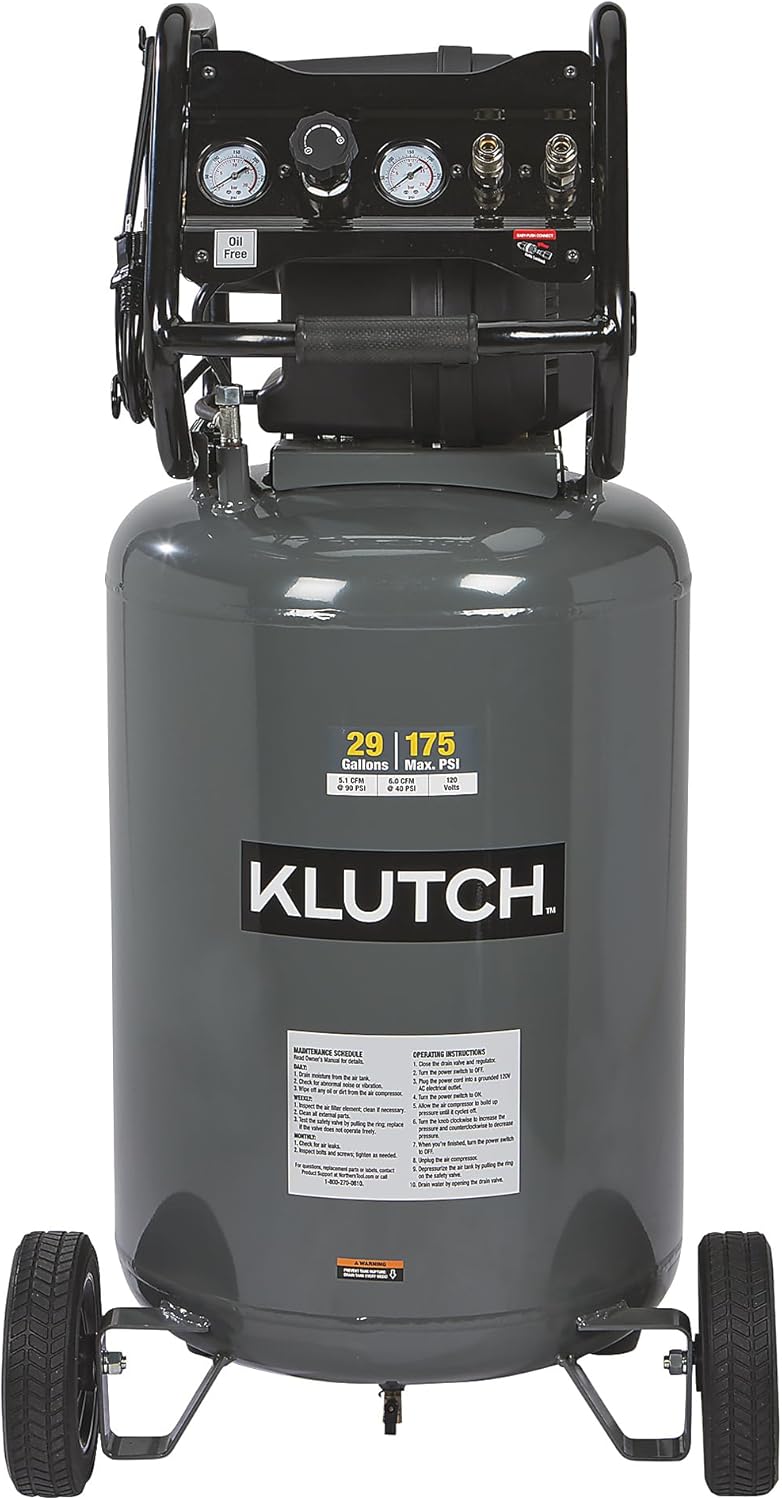
29 gallons. 175 PSI. 2.5 HP. 5.1 SCFM at 90 PSI. Flat-free tires. Brass quick-connect coupler. One buyer left it pressurized at 175 PSI for a full week; it held. Runs every air tool without complaint. $300 for this capacity is genuinely good value.
Let's be direct about 81 dB: this is not a quiet compressor. It's a quieter-than-average shop compressor. The comparison class is the 85-90 dB pancake compressors that come standard in most garages. Relative to those, this is better. In absolute terms, extended use at 81 dB requires ear protection. If you have close neighbors, plan your timing accordingly.
Mixed signals on durability: bent wheel brackets and pressure-building issues reported alongside otherwise positive feedback. One data note: this product appears to share its Amazon review pool with Klutch's 20-gallon model, so the aggregate buyer sentiment is less reliable than it would be for a standalone product. Best for buyers who need maximum shop capacity at a reasonable price and who will wear hearing protection.
We earn a commission on purchases via these links. It does not change the price you pay or our ranking.
The Tankless Option
One product on this list doesn't fit any category. Worth knowing about, not without reservations.
TC·BL Portable
16.5 lbs, no tank. Impressive concept, E-error reliability problem.
TC·BL Portable
16.5 lbs, no tank. Impressive concept, E-error reliability problem.
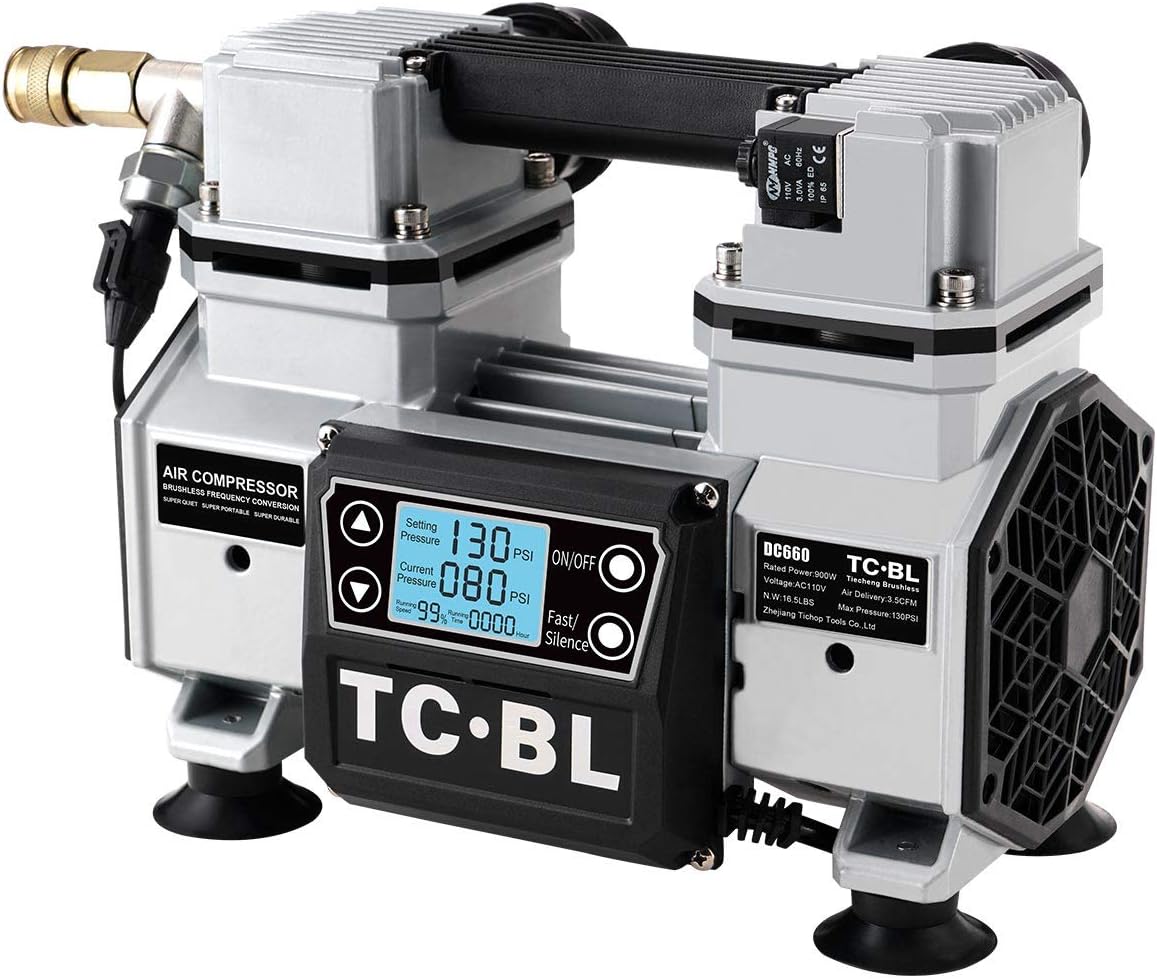
No tank. That's the entire concept. A permanent magnet motor, digital LCD controller, 16.5 lbs. You pick it up and carry it to where the work is. For trim work and light nailing, one buyer said he doesn't see the need for a tank-style compressor ever again. That's a strong statement from someone who made the switch.
It runs 3 F30 nail guns, handles air screwdrivers, inflates tires. Surprisingly capable for something that fits in a tool bag. 75 dB is not quiet in absolute terms, but portability is the actual sell, not silence.
The reliability problem is real and you should know about it. Error code E shutdowns appear across buyer feedback. When this compressor works, it's impressive. When it doesn't, you're on a job site with no air. For dedicated shop use where you want a light unit, the risk is lower. For a primary job-site compressor, a tanked unit with a proven track record is safer.
We earn a commission on purchases via these links. It does not change the price you pay or our ranking.
How to Buy a Quiet Air Compressor
The RPM number nobody checks
Motor RPM tells you more about noise than the advertised dB number. A 1680 RPM motor will always be quieter than a 3450 RPM motor, full stop. Lower RPM means less vibration, less mechanical noise, less annoyance. California Air Tools built their reputation on this single design choice. Check the motor RPM before you buy anything.
Why compressor dB claims are less reliable than most
There is no enforced industry standard for measuring consumer compressor noise. No required distance. No required load condition. One brand measures at 2 meters unloaded; another at 1 meter under load. The same compressor could be legitimately labeled anywhere in a 10+ dB range depending on methodology. Treat manufacturer specs as rough category placement. Buyer feedback is what actually tells you what you'll hear.
What the dB numbers mean in practice
Oil-free vs. oil-lubricated: the tradeoff nobody talks about
Oil-free wins on convenience. You never change the oil. You can use it at any angle. Oil-lubricated wins on noise and longevity. The oil film dampens metal-on-metal clatter. If your compressor lives in one spot in your garage, oil-lubricated will be quieter and last longer. If you carry it to job sites, oil-free is more practical. The 30 dB compressor on this page is oil-lubricated. That's not a coincidence.
Tank size as noise management
Larger tanks mean less frequent motor cycling. A 13-gallon compressor running its motor twice per hour is less annoying in practice than a 1-gallon unit cycling every 90 seconds, even at identical peak dB. For home garage use, buying more tank than you need is a legitimate noise reduction strategy. The motor is still just as loud when it runs; it just runs far less often.
Apartment and condo use
Most residential noise ordinances cap at 50-60 dB. Even the "quiet" 70 dB models technically violate this. For shared-wall living, stay at 60 dB or below, and use it during daytime hours. Vibration isolation pads under the compressor ($15-30 at any hardware store) reduce transmitted noise through floors and workbenches. Concrete garage floors amplify vibration. A $20 rubber mat makes a real difference.
Compressors get louder over time
Bearing clearance widens as parts wear. A compressor starting at 60 dB can be noticeably louder after 2-3 years of regular use. Oil-free compressors wear faster than oil-lubricated ones. The rated pump life (2,000-3,000 hours for consumer oil-free models) is the clock to watch. If yours starts sounding rougher after a year, worn bearings are the likely cause.
How We Rate Air Compressors
Air compressor noise specs are typically advertised prominently, but often measured at idle or light load - not at the duty cycles real workshop use demands. Our scoring draws on manufacturer specs, independent field testing (Project Farm and other reviewers with consistent methodology), social signals from contractor and workshop forums, and verified buyer feedback from sustained-use scenarios.
Frequently Asked Questions
What decibel level is considered quiet for an air compressor?
Under 70 dB is generally "quiet" for this category. Under 60 dB is genuinely impressive for a piston compressor. A normal conversation runs about 60 dB. Most standard compressors hit 75-90 dB, so anything in the 56-65 dB range is a real, noticeable improvement.
Are California Air Tools compressors really that quiet?
Yes. Independent testing has found their 60 dB models sometimes measure even quieter than advertised (one test came in at 50.6 dB for the 8010). The 1680 RPM motor design is the engineering reason. Buyers consistently back up the noise claims. The durability picture is less uniformly positive, particularly for the larger models.
Can I use a quiet air compressor in an apartment?
If it's under 60 dB and you use it during daytime hours, probably. Most residential noise ordinances sit at 50-60 dB for nighttime, slightly higher for daytime. Rubber vibration isolation pads under the unit reduce transmitted noise to neighbors below. A 1-gallon unit at 56 dB is workable for light use. A 10-gallon at 70 dB is not an apartment compressor.
Is oil-free or oil-lubricated quieter?
Oil-lubricated is quieter. The oil film dampens mechanical clatter that makes piston compressors loud. Oil-free dominates the market because buyers prefer no maintenance. If noise is your primary concern and the compressor stays in one spot, oil-lubricated is the better choice. If you move it around or use it in the field, oil-free is more practical.
How can I make my existing air compressor quieter?
Rubber vibration isolation pads under the feet ($15-30) reduce transmitted noise. Move the compressor as far from your work area as possible and use a longer hose. Build or buy a ventilated enclosure around it. Replace worn intake filters. These steps won't turn an 85 dB compressor into a 60 dB one, but they can shave 5-10 dB off perceived noise. The most effective move is still buying a quieter compressor.