Ceiling Fans · 2026 edition
Quietest ceiling fans that actually live up to the claim
Ceiling fan manufacturers publish dB specs the way food companies publish serving sizes: technically a number, but not the one that reflects how you actually use it. The quietest ceiling fans are quiet because they use DC motors, not because someone measured them in a lab. No independent body certifies ceiling fan noise. Every dB number on a product page is self-reported.
That matters because some of those numbers are implausible. One fan on this page claims 20 dB, which is near the threshold of human hearing. We'll get to it. The real signal is what buyers report after months of bedroom use, not what the spec sheet says on day one. We tracked owner feedback across 12 flush-mount ceiling fans to find the ones that actually earn the word "quiet."
All 10 picks at a glance
Every fan on this page. Noise tier is editorial judgment from buyer feedback, not the manufacturer's dB claim. No certification body covers ceiling fan noise, so we don't pretend one does. The ~20 dB? entry gets a question mark for a reason.
| Product | dB | Size/Motor | Price | Badge | Verdict |
|---|---|---|---|---|---|
| ZMISHIBO 52 Inch Ceiling Fan with Light | Quiet DC | 52" DC | $64 | Quietest Overall | Best noise-to-price at 52 inches. Buyers genuinely forget it is on. |
| TALOYA 52 inch Ceiling Fans with Lights Remote Control | <30 dB | 52" DC | $110 | Best Plastic Blades Pick | Four-fan repeat buyer story. Smart-home ready. Plastic blades outlast the skeptics. |
| Dolavast Ceiling Fans with Lights | 30 dB | 52" DC | $90 | Specific 30 dB claim with buyer backing. Natural Wind mode a real differentiator. | |
| OJX Ceiling Fans with Lights | ~20 dB? | 52" DC | $60 | 20 dB claim is implausible; buyers say quiet, but don't corroborate the spec. | |
| Roomratv Ceiling Fans with Lights and Remote Control | 35 dB | 52" DC | $95 | Honest 35 dB; quiet enough for sleep. Proprietary LED panel is the long-term caveat. | |
| ZOUQILAI Ceiling Fans with Lights | Quiet DC | 42" DC | $46 | Best Budget Pick | Under $50. One buyer returned a pricier store fan for this one. |
| Ceiling Fans with Lights | ≤30 dB | 42" DC | $43 | Cheapest on the list. Quiet at high speed. Instructions need work. | |
| ocioc Quiet Ceiling Fan with LED Light 22 inch Large Air Volume Remote Control for Kitchen Bedroom Dining Room Patio | Quiet | 22" DC | $49 | Only 22-inch on this page. Remote-dependent operation. Small rooms only. | |
| Fszdorj 20‘’ Ceiling Fan with Light | Quiet DC | 20" DC | $70 | Best Smart Control Pick | Bluetooth app plus standalone night-light. Small rooms and smart-home setups. |
| LANMEL 42'' Ceiling Fan with Lights and Remote | 30 dB | 42" DC | $55 | Gold finish. Nursery-confirmed quiet. Limited timer options. |
Quiet 52-Inch Fans
The 52-inch flush-mount is the workhorse for bedrooms and living rooms. Five options cleared the noise bar based on what buyers actually report running these in their homes, not what the marketing copy says.
Quietest Overall ZMISHIBO 52-Inch Ceiling Fan
Best noise-to-price ratio at 52 inches. Buyers genuinely forget it's on.
ZMISHIBO 52-Inch Ceiling Fan
Best noise-to-price ratio at 52 inches. Buyers genuinely forget it's on.
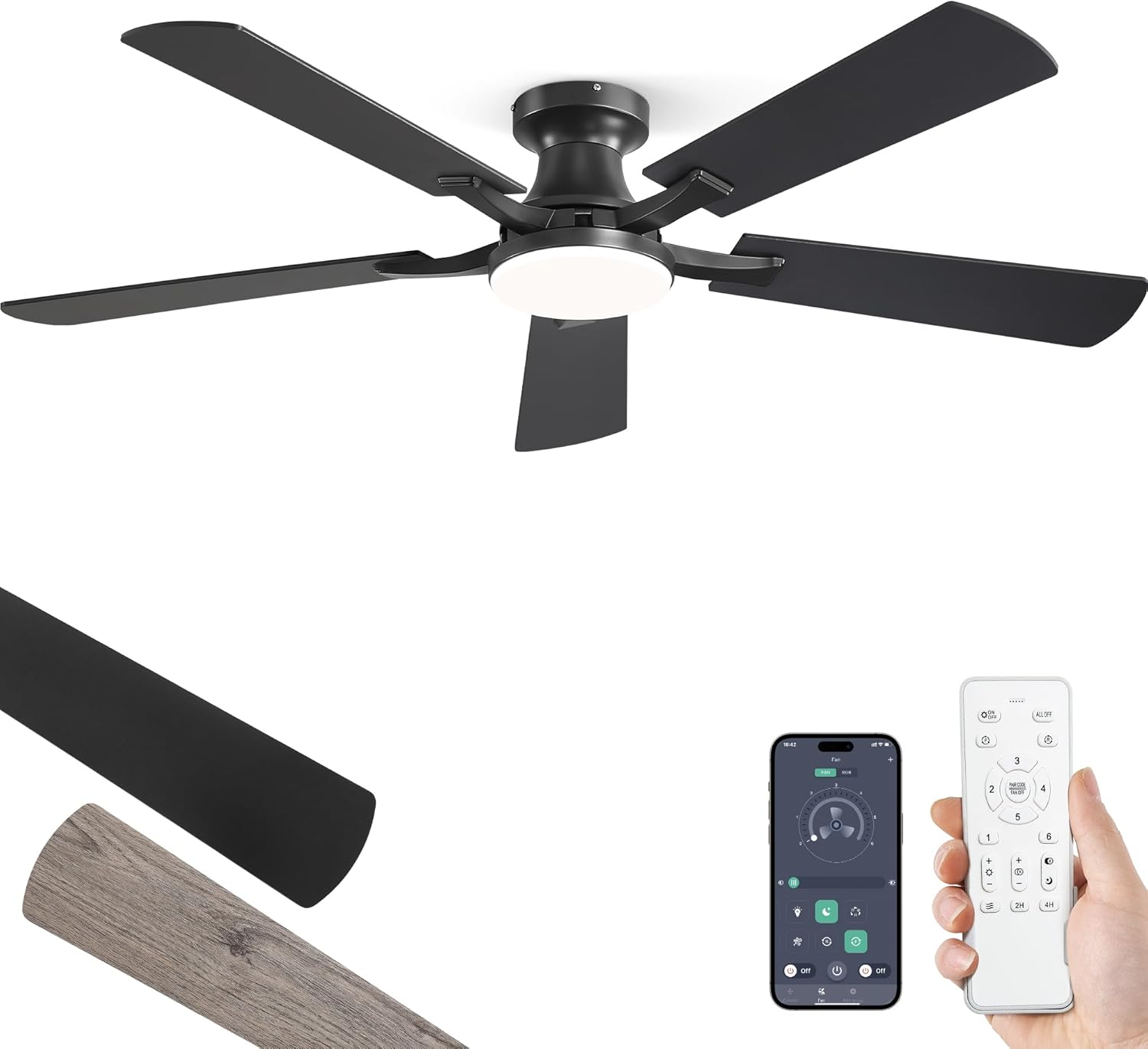
At $64, this fan has no business running this quietly. The DC motor eliminates the 60 Hz winding hum that cheap AC fans carry, and buyers with experience installing a dozen ceiling fans over the years describe the value as something they didn't expect. The package arrives surprisingly small and light; assembly runs under an hour with one person.
Buyers running this in primary bedrooms describe being unable to tell it's on at high speed. That's the quiet ceiling fan benchmark, and at $64, this one passes it. Six speeds, reversible motor, app or remote control, stepless dimming with three color temperatures. Standard feature set, nothing missing.
Long-term note: The LED light panel is proprietary. If the disc fails, you replace the whole panel, not a bulb. Replacement panels are available and inexpensive, but it's worth knowing going in.
Minor quirk: The night-light color temperature doesn't persist after a power cycle. You'll re-select it each time. Not a dealbreaker, but it's in the buyer feedback.
We earn a commission on purchases via these links. It does not change the price you pay or our ranking.
Best Plastic Blades Pick TALOYA 52-Inch Ceiling Fan
Premium quiet backed by a reviewer who installed four and never looked back.
TALOYA 52-Inch Ceiling Fan
Premium quiet backed by a reviewer who installed four and never looked back.
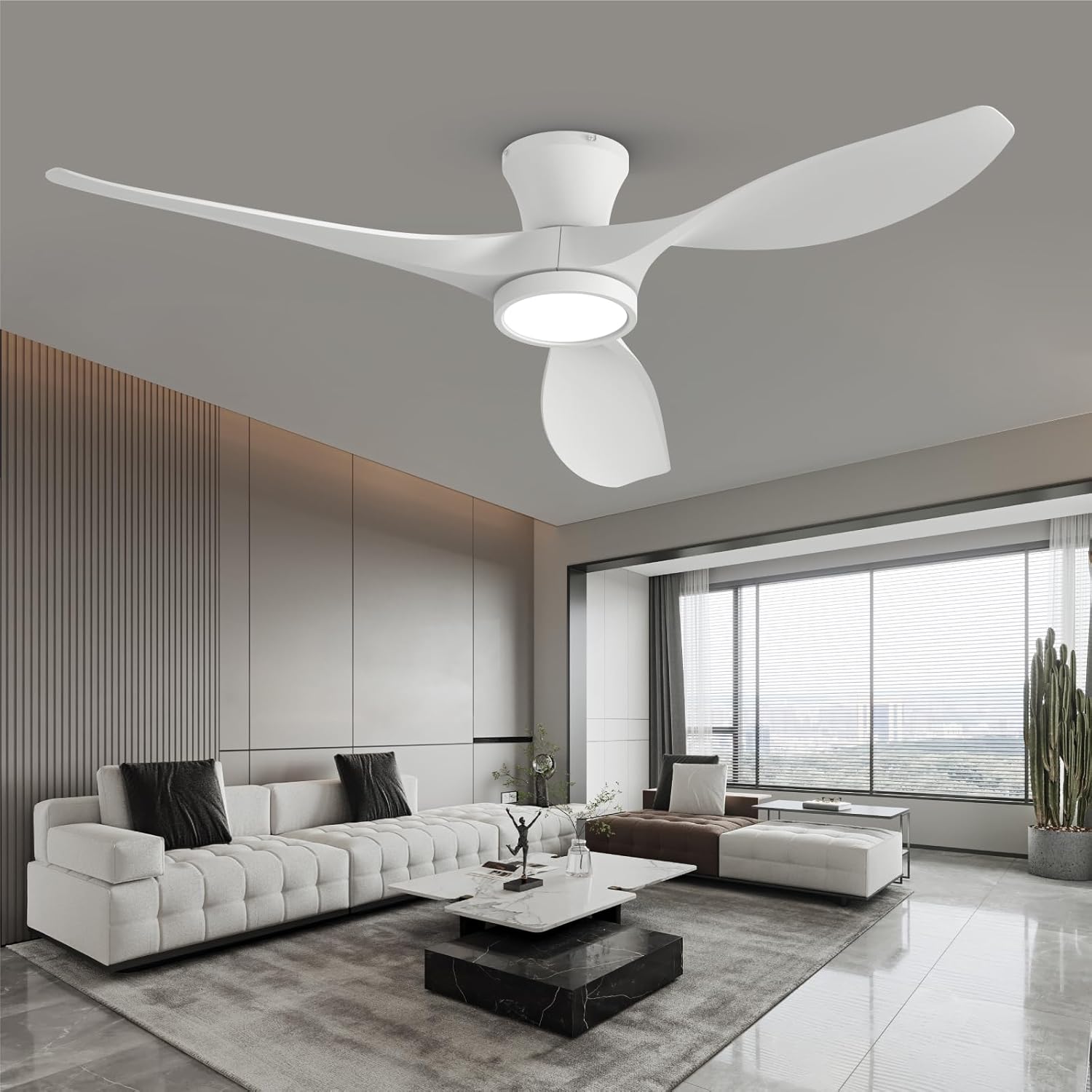
The best signal for a ceiling fan isn't one glowing review. It's someone who bought the first one, liked it enough to buy a second, then a third, then a fourth to replace every fan in their home. That's what happened here. The TALOYA earned a whole-house swap from someone who could have bought anything. The stated-to-be-under-30 dB has buyer support: buyers describe the motor as remarkably quiet while producing strong airflow at high settings.
The smart-home story is real. Tuya-based Wi-Fi pairs with Smart Life, SmartThings, and Home Assistant. Local control via LocalTuya works after some setup effort. Fan speed and light color temperature are both adjustable through automations. For a $110 ceiling fan, that's more home-automation depth than the category usually offers.
One caveat is honest: the plastic blades look better at a distance than up close. They are thick, durable, and humidity-resistant (good news for Florida homes), but inspection under bright light reveals their construction. The 3-blade design also replaces what was likely a 5-blade fan in most installations. The airflow is strong, so the trade-off is mostly aesthetic. Batteries for the remote are not included.
We earn a commission on purchases via these links. It does not change the price you pay or our ranking.
Dolavast 52-Inch Ceiling Fan
One of the few 30 dB claims on this page that buyer feedback actually backs up.
Dolavast 52-Inch Ceiling Fan
One of the few 30 dB claims on this page that buyer feedback actually backs up.
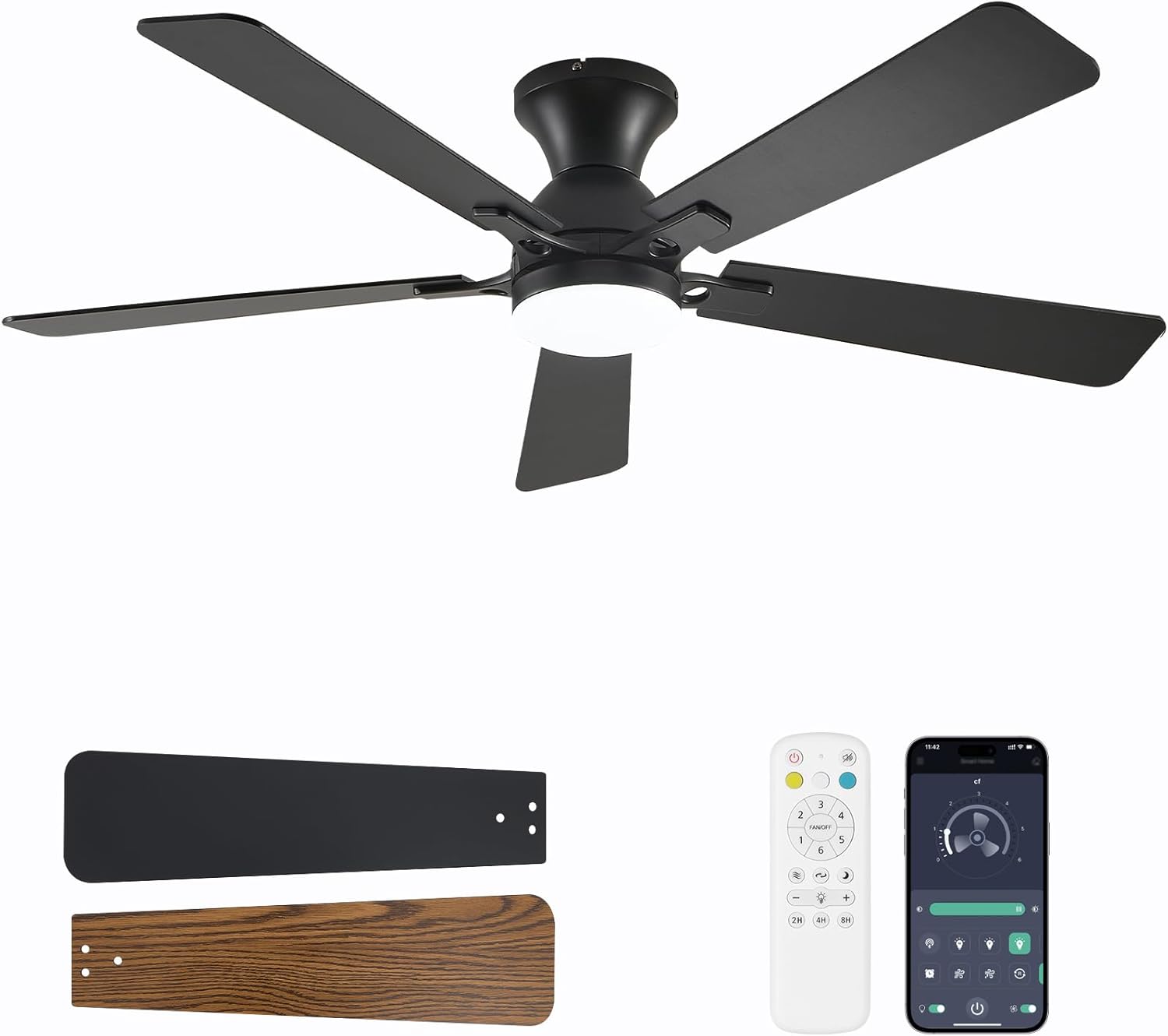
Most ceiling fan dB numbers exist purely to rank in search results. The Dolavast's 30 dB claim is different in that buyers specifically mention the quiet DC motor and several came back to buy additional units for other rooms. That repeat-purchase behavior is a better signal than any star rating.
The Natural Wind mode (which cycles speeds 1 through 6 and back, mimicking an outdoor breeze) is a feature buyers actually notice and use. It's not standard on fans at this price. The double-sided plywood blades reversible between black and walnut finishes add design flexibility without requiring any hardware changes.
Remote batteries aren't included. Installation with two people is easier; solo is doable. The fan has a smaller-looking motor housing than many 52-inch competitors, which is why buyers tend to choose the 52-inch for rooms where they might otherwise pick 44.
We earn a commission on purchases via these links. It does not change the price you pay or our ranking.
OJX 52-Inch Ceiling Fan
The 20 dB claim is implausible. The fan itself seems to actually be quiet.
OJX 52-Inch Ceiling Fan
The 20 dB claim is implausible. The fan itself seems to actually be quiet.
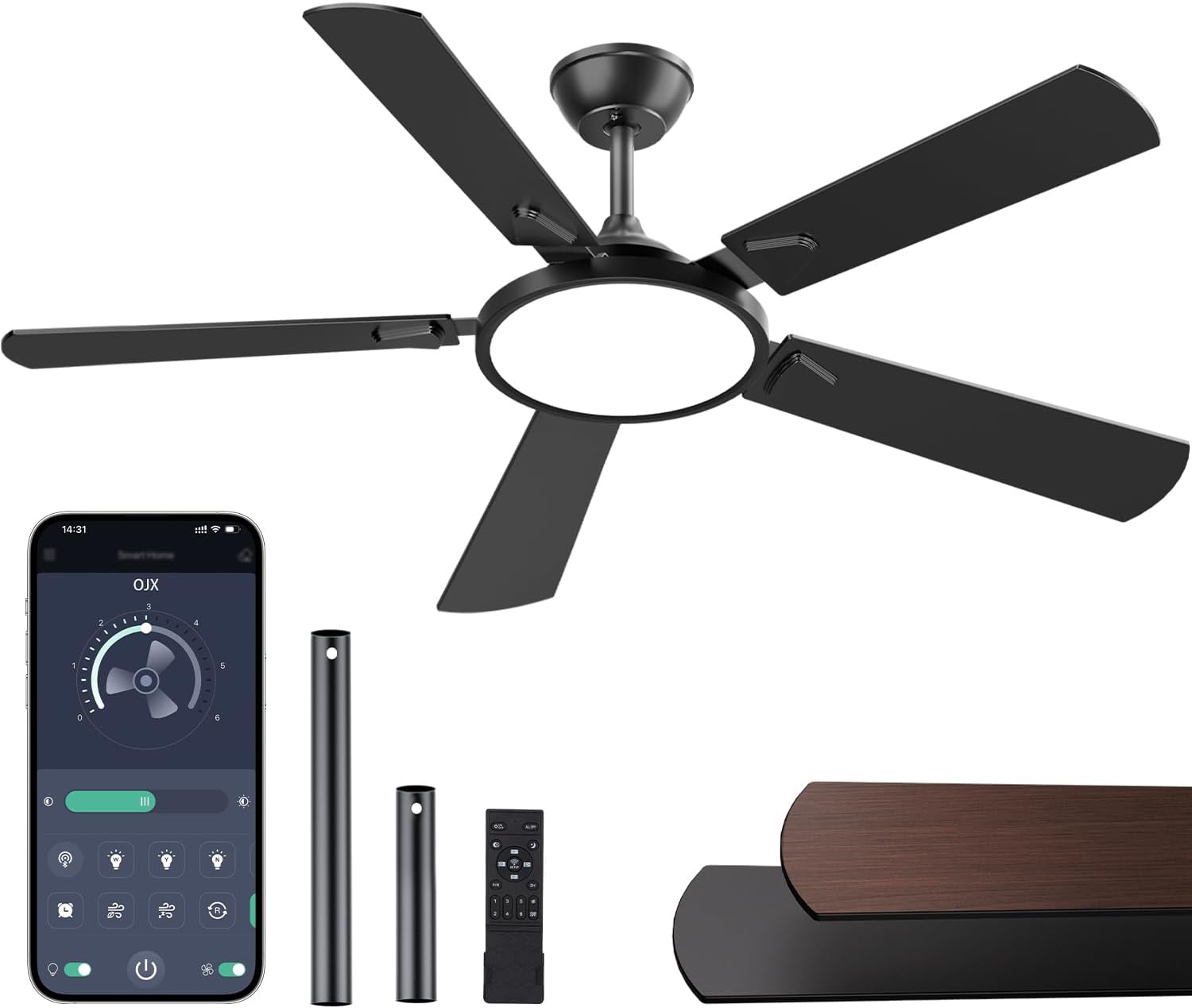
The OJX listing states "whisper-quiet operation (low to 20dB)." That's near the threshold of human hearing. For context: a recording studio is around 30 dB. A library is 40 dB. No residential ceiling fan has been independently verified anywhere near 20 dB. The number is marketing.
What the buyers actually say: it's quiet. They don't say it's 20 dB quiet. They say it moves air well and doesn't disturb the room. That's a good fan. Families buying multiple units are in the buyer base. At $60 it competes with the ZMISHIBO on price; the ZMISHIBO has a deeper review pool and no implausible spec claims, which is why it's ahead.
We earn a commission on purchases via these links. It does not change the price you pay or our ranking.
Roomratv 52-Inch Ceiling Fan
35 dB is the honest number. That's still quiet enough for most sleepers.
Roomratv 52-Inch Ceiling Fan
35 dB is the honest number. That's still quiet enough for most sleepers.
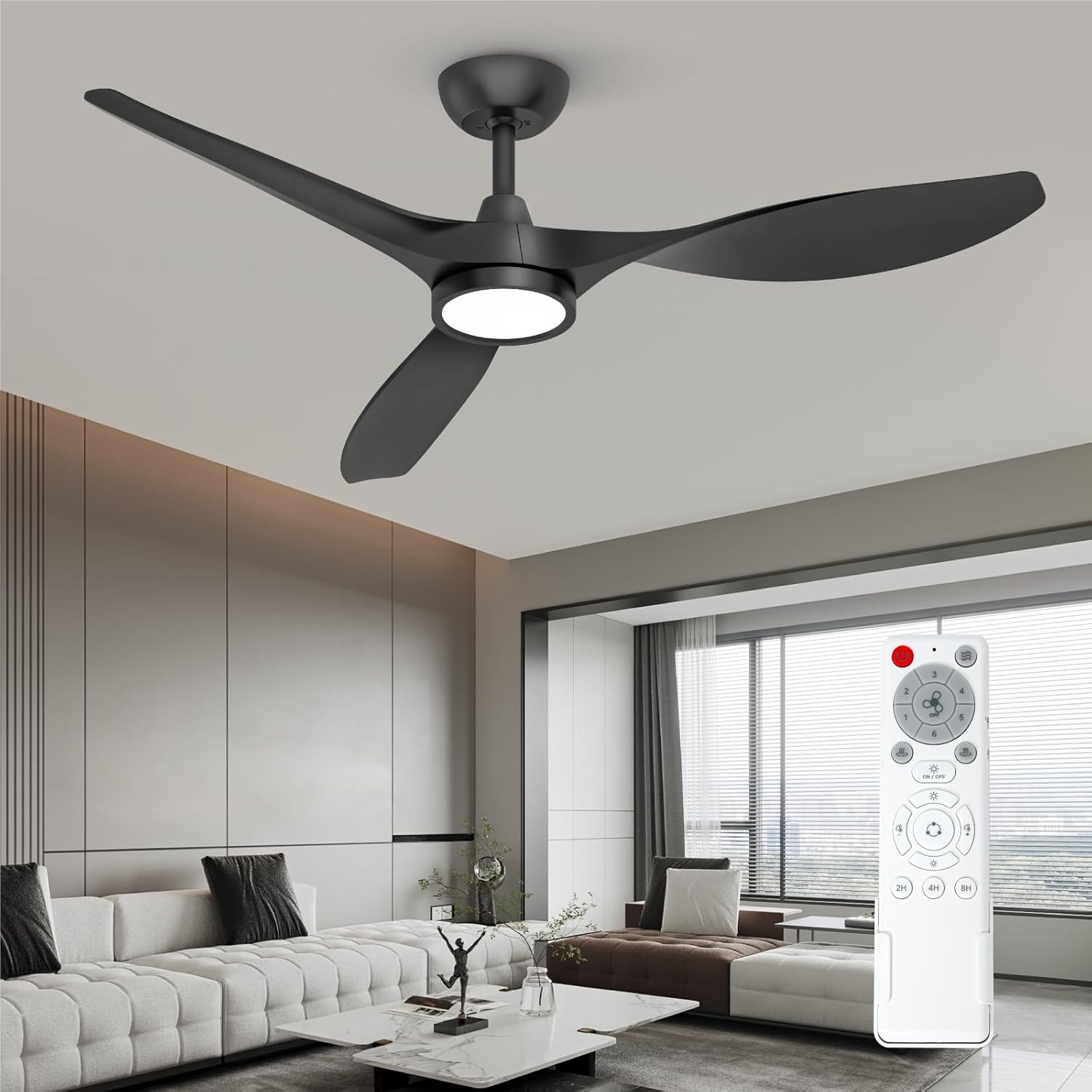
The Roomratv is notable for publishing 35 dB, which is higher than competing claims but also more honest. Thirty-five decibels is a quiet library. Most people sleep through it without issue. Buyers in the review base confirm quiet operation and several replaced older noisier fans across multiple rooms.
The integrated ABS blade design, where blades attach directly to the motor housing without separate brackets, is a structural choice meant to reduce wobble. It works; wobble-induced clicking is absent from the feedback. The remote wall bracket is a practical inclusion that few competitors bother with.
The proprietary LED light is the long-term caveat here too: no bulb replacements, only full-panel swaps. At $95 the fan needs to last for years to justify the price, which makes the non-replaceable light a legitimate concern. It is a known limitation going in.
We earn a commission on purchases via these links. It does not change the price you pay or our ranking.
Small-Room and Budget Fans
Smaller blade spans and lower prices for tighter spaces. The 42-inch picks are appropriate for rooms up to 225 sq ft; the 22-inch is for genuinely compact spaces or very low ceilings.
Best Budget Pick ZOUQILAI 42-Inch Ceiling Fan
Under $50, quiet at every speed, and buyers keep coming back with positive updates.
ZOUQILAI 42-Inch Ceiling Fan
Under $50, quiet at every speed, and buyers keep coming back with positive updates.
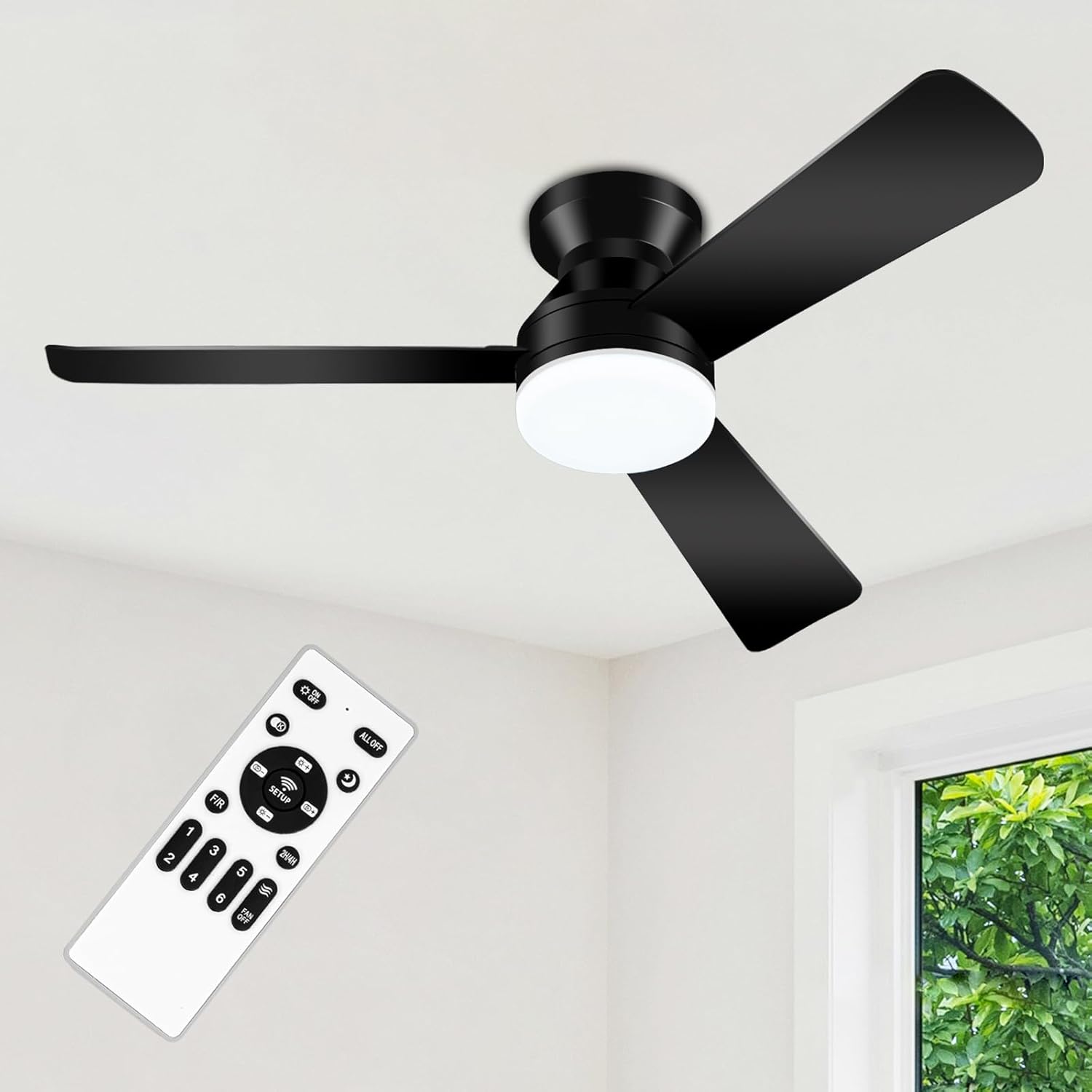
A buyer returned a more expensive fan from a big-box hardware store because it was too loud after installation. Bought this for about $40. Got a quiet fan. That comparison is the argument for this product. The DC motor runs at every speed without the AC hum that cheaper fans carry, and buyers describe quiet at even the highest setting.
One operational note: the wall switch controls the light only. The fan itself only responds to the remote. This is common for DC fans with memory functions, but it catches people off-guard. Don't lose the remote. The reversible blade design (retro on one side, modern on the other) is a practical style feature; the plastic construction is apparent at close range but holds up fine in daily use.
We earn a commission on purchases via these links. It does not change the price you pay or our ranking.
DAHUICFL 42-Inch Ceiling Fan
The cheapest 42-inch here. Buyers confirm quiet at high speed; instructions need help.
DAHUICFL 42-Inch Ceiling Fan
The cheapest 42-inch here. Buyers confirm quiet at high speed; instructions need help.
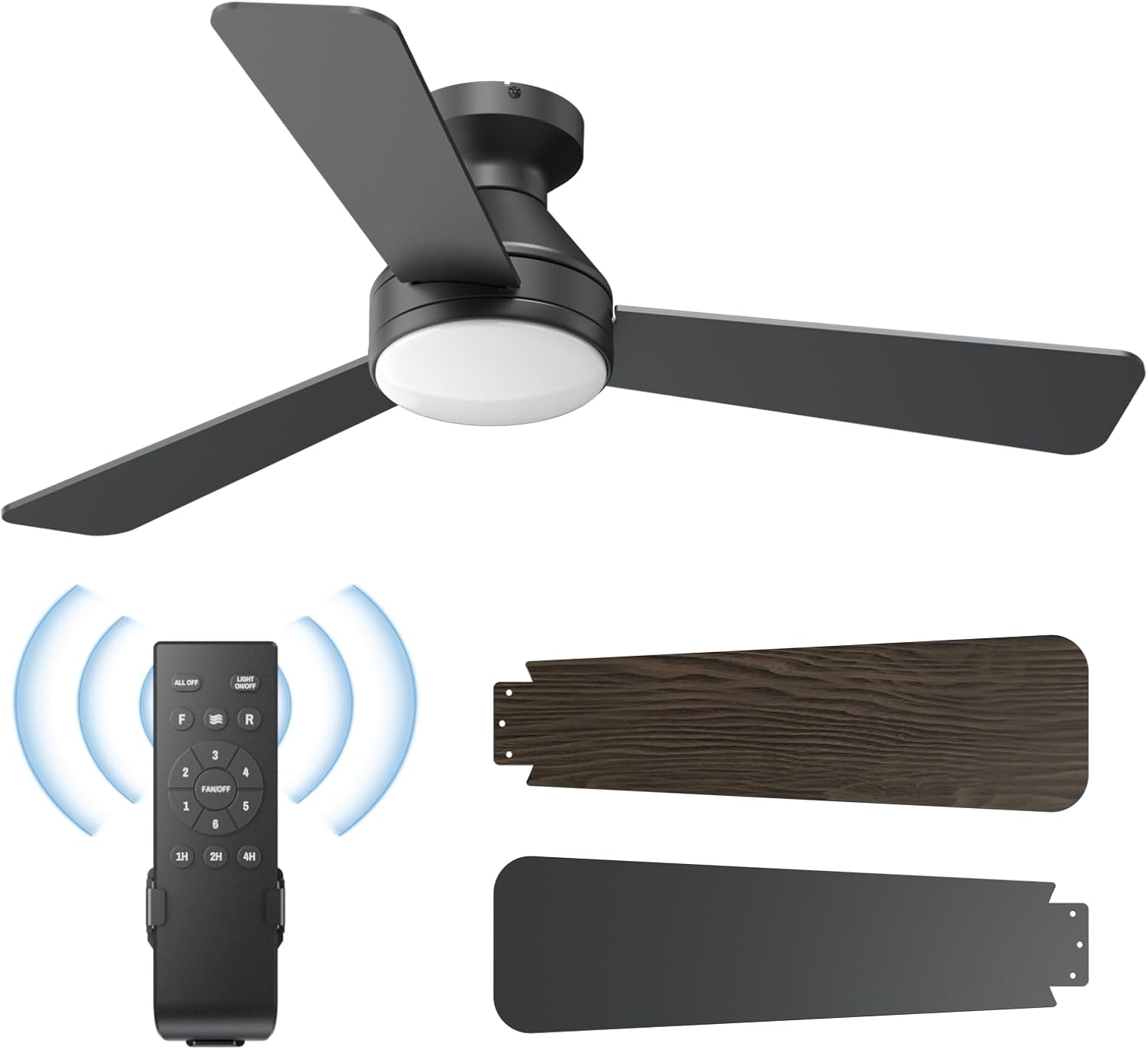
At $43, this is the floor of the 42-inch DC category on this page. The stated-to-be-under-30 dB claim has buyer support: reviewers specifically note no noise at the highest speed setting, which is where cheaper fans expose themselves. Airflow for the size is strong. The sleek black profile integrates cleanly into most modern interiors.
The instructions are rough. The translation quality is poor and the diagrams carry most of the weight. For anyone who's wired a fan before, it's manageable. For a first install, watching a generic ceiling-fan wiring video first is the practical move. That's the trade-off at $43.
We earn a commission on purchases via these links. It does not change the price you pay or our ranking.
ocioc 22-Inch Ceiling Fan
The right format for small rooms and low ceilings. Read the remote caveat.
ocioc 22-Inch Ceiling Fan
The right format for small rooms and low ceilings. Read the remote caveat.
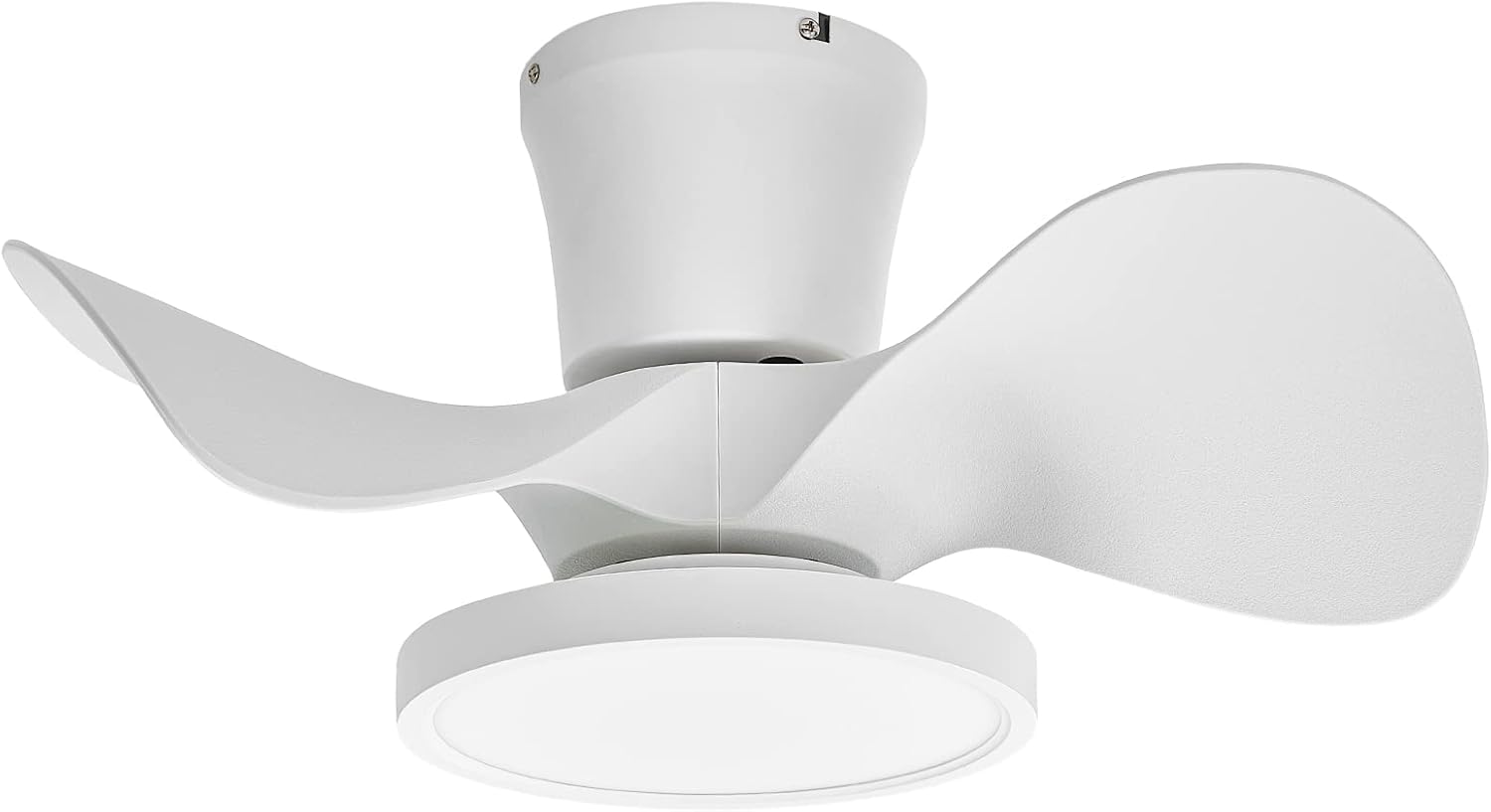
The 22-inch format exists for spaces where a 42-inch fan would be overkill or where ceiling height makes a larger fan impractical. The ocioc is the most validated product in this format, with an extensive buyer base spanning bedrooms, kitchens, and outdoor covered spaces. Noise feedback is consistently positive. For a compact fan, it moves a reasonable amount of air.
The gotcha: the wall switch powers the circuit, but the fan only activates via remote. Every time you flip the switch, the fan waits for a remote signal to turn on. There's a 2-3 second start delay after powering the circuit. If you lose the remote, you lose the fan function. Keep a known location for it. The LED light also covers the room less evenly than a multi-bulb fixture, with some buyers noting dimmer corners. That's the physics of a single LED disc; it's not fixable, just something to know.
We earn a commission on purchases via these links. It does not change the price you pay or our ranking.
Smart Control and Specialty Picks
App-connected fans and the one with a genuinely distinctive design angle. Different use case, different buyer.
Best Smart Control Pick Fszdorj 20-Inch Ceiling Fan
A 20-inch fandelier with a standalone night-light and Bluetooth app control.
Fszdorj 20-Inch Ceiling Fan
A 20-inch fandelier with a standalone night-light and Bluetooth app control.
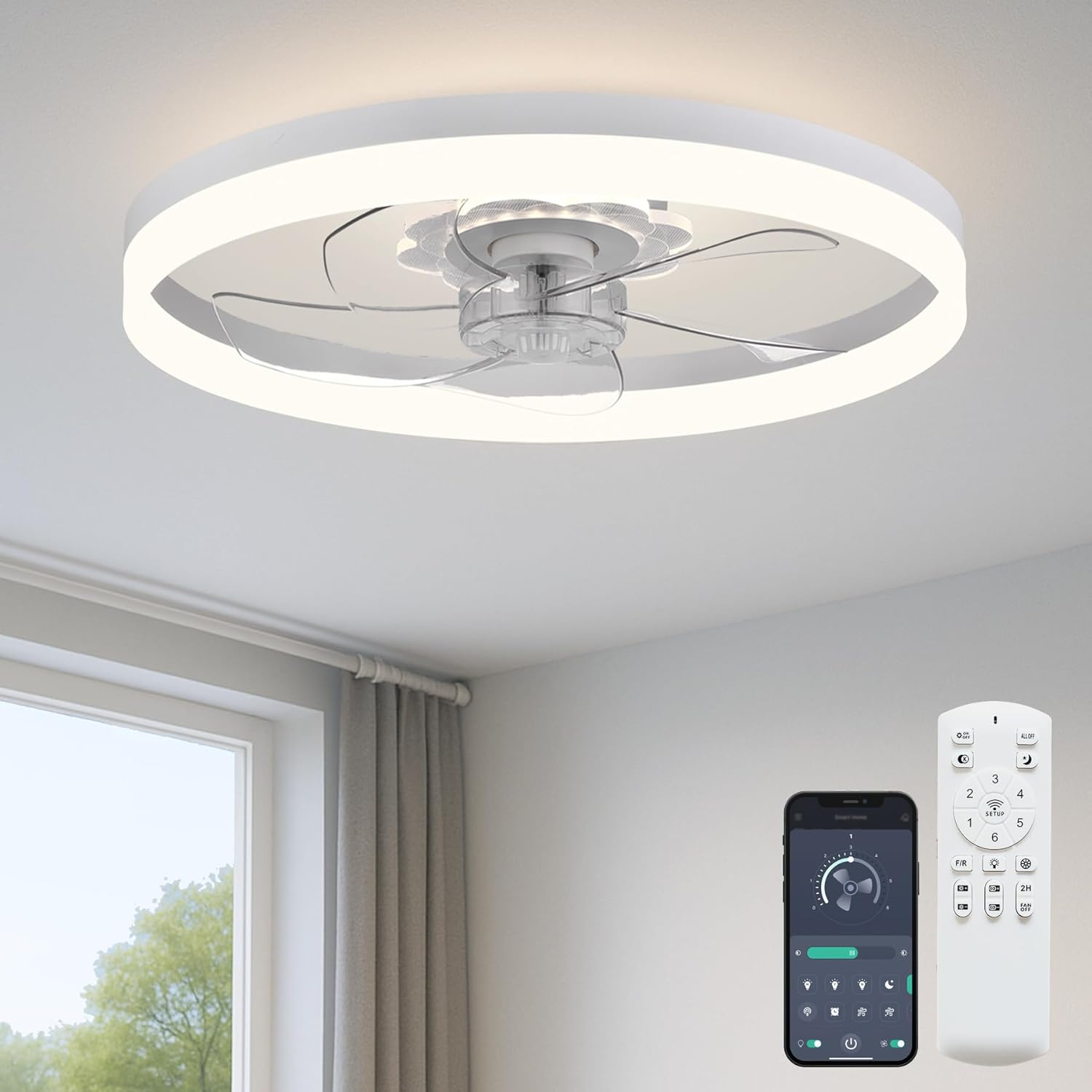
Twenty inches is the smallest fan on this page, designed for compact bedrooms, home offices, and kitchens where a larger format doesn't make sense. The defining feature is the standalone night-light: a separate lighting element with its own color options (violet, warm blue, soft warm) that operates independently of the main light. It's genuinely useful for bedrooms where you want ambient light without full ceiling brightness at 2 AM.
The Bluetooth app control is the smart-home angle, with independent control of fan speed, light color, brightness, and timers from a phone. The limitation versus the TALOYA is the connection type: Bluetooth, not Wi-Fi. That means no remote access when you're away from home and no integration into Wi-Fi-based home automation systems like Home Assistant. For basic smartphone control within range, it works. For deeper smart-home integration, the TALOYA is the better fit.
Buyers in small bedroom setups describe it as powerful for its size and genuinely quiet. One installation note: the ceiling mount may require drywall anchors depending on your ceiling box configuration. Check your junction box before purchasing.
We earn a commission on purchases via these links. It does not change the price you pay or our ranking.
LANMEL 42-Inch Gold Ceiling Fan
A gold-finish fan that buyers worried about, then loved. 30 dB confirmed for nursery use.
LANMEL 42-Inch Gold Ceiling Fan
A gold-finish fan that buyers worried about, then loved. 30 dB confirmed for nursery use.
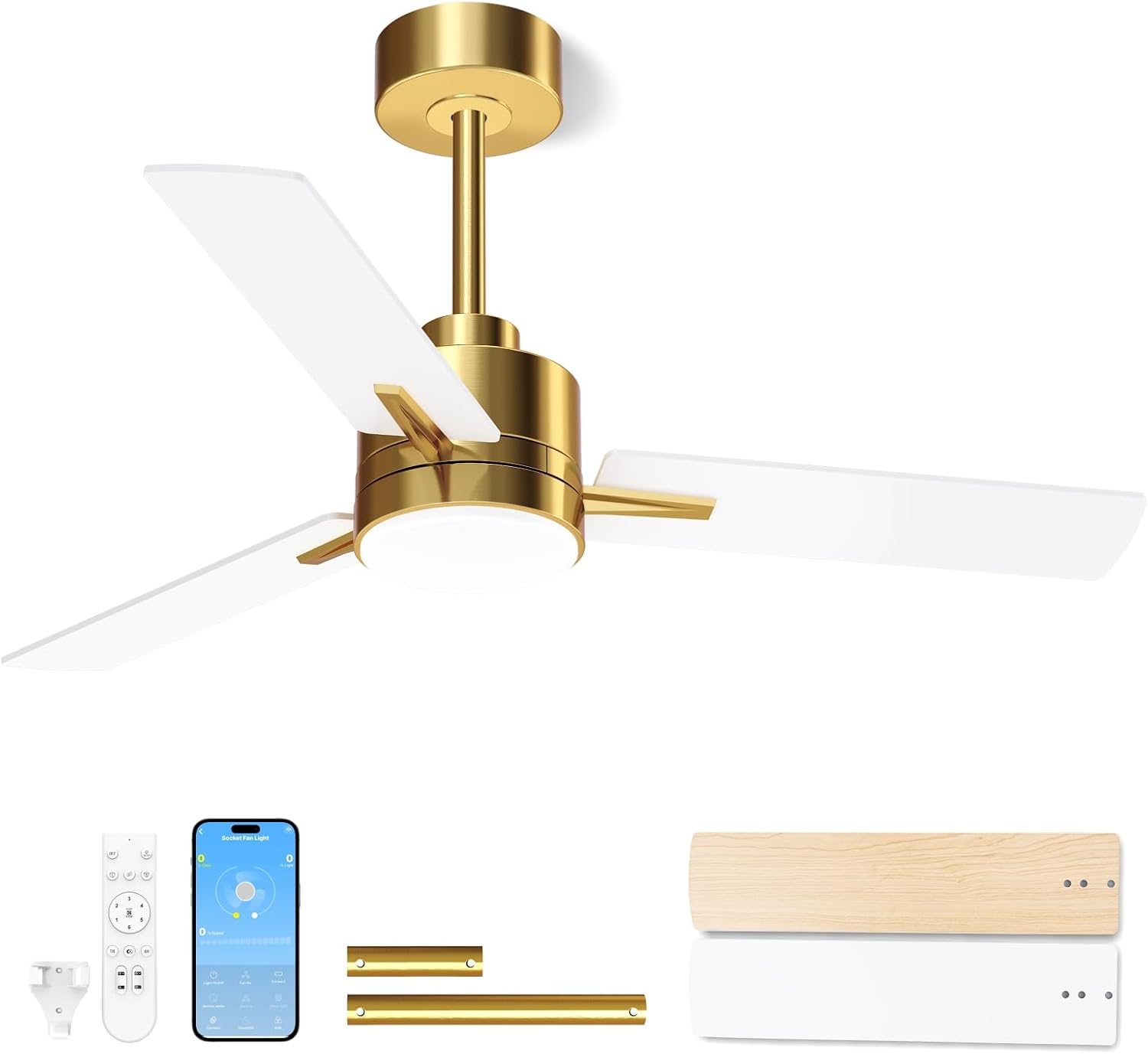
Every other fan on this page comes in black. The LANMEL is here specifically for the gold and white finish, which fills a gap the rest of the list doesn't cover. Buyers who worried the gold would look out of place describe it as fitting perfectly after installation. A nursery installation is in the buyer feedback, which is a meaningful quiet signal: if it works in a napping baby's room, the 30 dB claim has at least some real-world backing.
One limitation worth knowing: timer buttons top out at one and four hours. Competitors on this page offer two, four, and eight-hour options. For bedrooms where you want to set an eight-hour overnight timer, that's a real gap. The multi-unit basement installation in the buyer feedback suggests it works fine for practical daily use; the timer limitation is a feature gap, not a reliability concern.
We earn a commission on purchases via these links. It does not change the price you pay or our ranking.
What actually makes a ceiling fan quiet
DC motor vs. AC motor
This is the only distinction that materially affects noise. AC motors hum from 60 Hz electromagnetic winding vibration. It's inherent to the motor type, not a quality control issue. DC motors convert the AC input to direct current and run at variable frequencies with no 60 Hz hum. Every fan on this page uses a DC motor. Under $40 at 52 inches, assume you're getting an AC motor regardless of what the listing says.
Why dB numbers are unreliable in this category
Unlike dishwashers (tested under ENERGY STAR protocols) or portable generators (EPA/CARB certified), ceiling fans face no mandated acoustic testing. Every dB number on a ceiling fan product page is self-reported with no disclosed methodology. Some are measured in anechoic chambers at a specific distance. Some are estimated. The 20 dB claim on the OJX is a reminder that the numbers exist to win searches, not inform buyers.
Noise reference scale for this category
Blade count doesn't determine noise
The idea that more blades means a quieter fan is persistent and mostly wrong. Motor noise is the dominant factor, and motor noise has nothing to do with blade count. Blade count affects airflow distribution and aesthetics. The 3-blade fans on this page are not louder than the 5-blade fans. The DC motor is what matters.
Room sizing matters more than you think
An undersized fan running at maximum speed to cool the room is louder than a correctly sized fan at medium speed. The math: 52-inch fans for rooms up to about 400 sq ft; 42-inch fans for rooms up to 225 sq ft; 20-22-inch fans for compact spaces under 150 sq ft. Getting the size right means you never need to run it at speed 6.
Remote-dependent operation
Several fans on this page require the remote to activate the fan. The wall switch powers the circuit; the fan stays off until the remote signals it. This is a deliberate design choice for DC fans with memory functions. It means: keep the remote somewhere consistent. Losing it locks you out of fan control. The ocioc, ZOUQILAI, and DAHUICFL all work this way.
Frequently asked questions
What is a good dB level for a bedroom ceiling fan?
30 to 35 dB is the credible quiet tier for DC motor fans. Anything claimed below 28 dB is almost certainly marketing. At 35 dB you're in quiet-library territory, which is fine for most sleepers. If you're a light sleeper in an otherwise silent room, aim for a fan with buyer reports describing it as nearly inaudible rather than one with a suspiciously low spec sheet number.
Are DC motor ceiling fans actually quieter than AC motor fans?
Yes, for a specific reason. AC motors run off 60 Hz current and create an audible electromagnetic hum from the winding vibration. DC motors don't have this; they run at variable frequencies with no inherent hum. The difference is most noticeable at low speeds where aerodynamic blade noise is low and motor noise dominates. At high speeds on a cheap AC fan, you hear both.
What makes a ceiling fan get louder over time?
Three causes. Bearing wear creates clicking or grinding that develops over months. Blade imbalance from manufacturing variance produces wobble-induced clicking that gets worse as hardware loosens from vibration. And end-of-life compressor or motor stress from running at high load constantly. DC motor fans tend to age better because variable-frequency drive reduces mechanical stress and DC motors have fewer moving parts to degrade.
Why does my ceiling fan only work with the remote?
DC motor fans with memory functions are often designed this way. The wall switch powers the circuit; the fan stays in its last-saved state until the remote signals a change. It's a deliberate choice that enables the fan to remember your preferred speed and light settings across power cycles. The trade-off is remote dependency. If you lose it, you can usually order a replacement from the manufacturer; the brand name and model number on the box are sufficient.
Does blade count affect how quiet a ceiling fan is?
Not in any meaningful way. Blade count affects airflow distribution and aesthetics. Motor noise is the primary driver of how quiet a fan is, and motor noise is entirely unrelated to how many blades are attached to the shaft. A 3-blade DC fan is quieter than a 5-blade AC fan. Blade material matters slightly more: plastic blades are lighter and more forgiving of minor imbalances than solid wood, which means less wobble-induced noise from manufacturing variance.