Desk Fans · 2026 edition
Quietest desk fans (2026 buyer picks)
Desk fan marketing is noise. Not the fan itself - the marketing. Every $8 USB fan claims to be quiet. Every spec sheet says something like "40-50 dB" without explaining that 40 dB in a silent bedroom is nothing like 40 dB in a shared office. The 30 dB gap between the quietest and loudest fans on this page is a fundamental difference in character. Most reviews never surface it.
We went through eight products looking for the ones where the quiet claim actually holds up. A 20 dB air circulator that buyers describe as near-inaudible on their nightstand. A $15 Honeywell that's been market-tested for a decade. And a handful of USB fans with honest trade-offs between price, airflow, and how much you'll notice them. Below: what made the cut and what didn't.
All eight at a glance
Sorted by dB spec. Click any product name to jump to the full take.
| Product | dB | Type | Price | Badge | Verdict |
|---|---|---|---|---|---|
| DREO Fan for Bedroom | 20 dB | Air Circulator | $29 | Quietest Overall | Near-silent circulator. Moves a whole room's air without announcing itself. |
| Honeywell TurboForce Air Circulator | 25 dB | Tabletop | $15 | Best Value Quiet | The benchmark. $15, decade-proven, 25 dB on low. Some durability variance. |
| SWEETFULL 6.5 Inch USB Small Desk Fan | 30 dB | USB Desktop | $15 | Best Budget Quiet | Wood grain finish, 360-degree tilt, legitimately quiet per buyer feedback. |
| KONSIDEN Desk Fan Bladeless | 30 dB | Bladeless | $32 | Bladeless, child/pet safe, smooth airflow. Power is limited at this price. | |
| KIMMOO Rechargeable USB Desk Fan | 35 dB | Rechargeable | $21 | Best Rechargeable Pick | 100-speed dial-in, 8+ hr battery, USB-C. Fine-grained quiet control. |
| Gaiatop USB Desk Fan | 40 dB | USB Portable | $8 | Best Budget Portable | $8, packs flat, adequate for travel and desk use at the budget ceiling. |
| Honeywell HTF210B QuietSet Personal Table Fan | 45 dB | Oscillating | $33 | Oscillates, 4 speeds, fine for offices. QuietSet branding oversells it. | |
| Gaiatop USB Desk Fan | 50 dB | USB Portable | $8 | Cheapest option. 50 dB is audible in a quiet room. Budget travel pick. |
Whisper-quiet circulators
Under 25 dB. If you're on video calls all day, sleeping light, or just done with fan noise, these two are the only ones worth considering.
Quietest Overall DREO Fan for Bedroom
Near-silent circulator. Moves a whole room's air without announcing itself.
DREO Fan for Bedroom
Near-silent circulator. Moves a whole room's air without announcing itself.
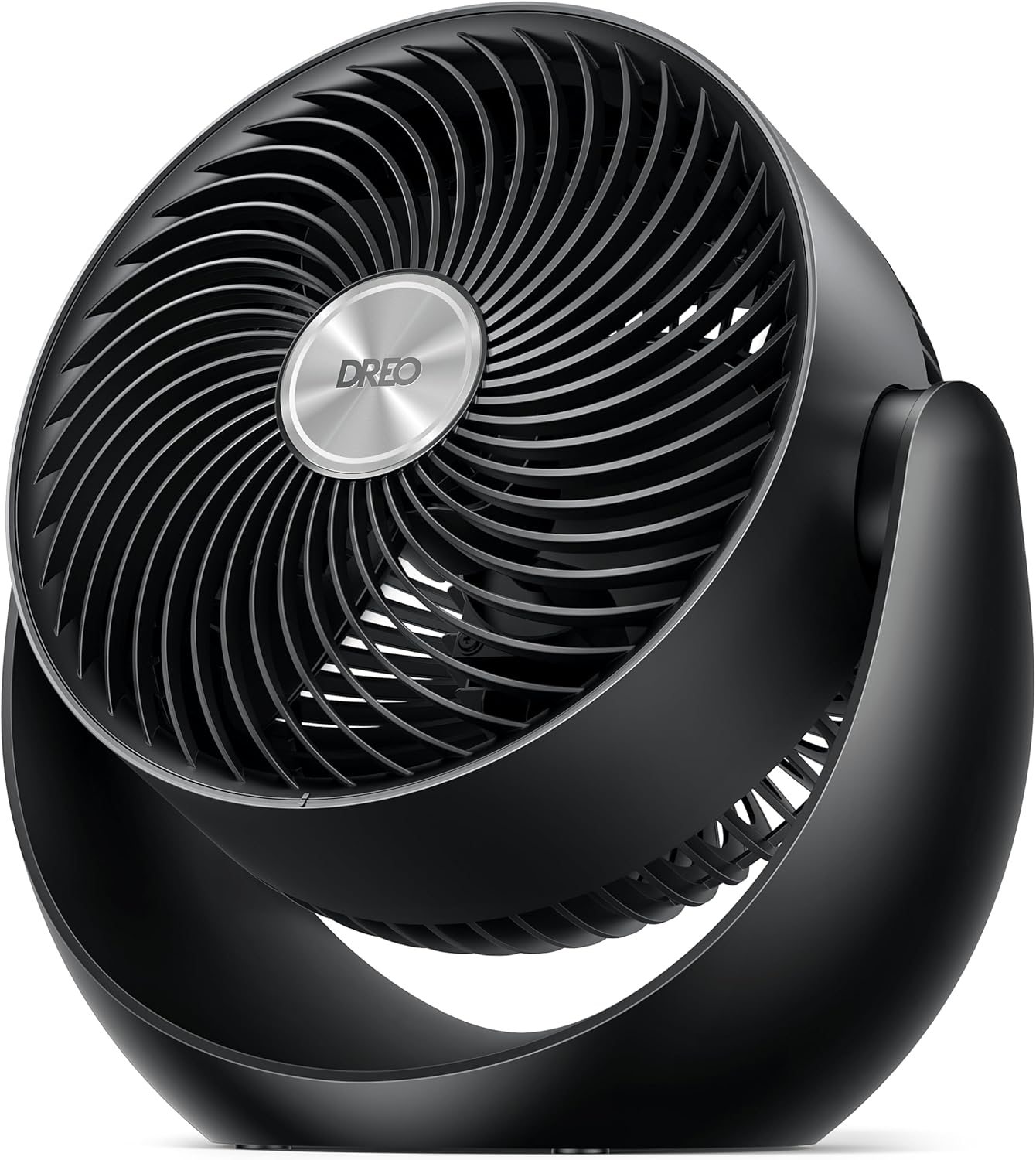
Call it a desk fan if you want, but the DREO is really an air circulator that fits on a desk. The ducted design pushes a focused column of air across 60 feet, then lets room air mix behind it. That physics difference is why buyers who run it overnight on a nightstand describe it as near-inaudible. They know it's on because air is moving. They don't know it's on because they can hear it.
On low, 20 dB is the quietest spec on this list by 5 dB. For context: a library reading room sits around 30-35 dB. This fan on low is quieter than that. If you're on video calls all day, or sharing a room with a light sleeper, this is the only option here that won't create friction.
One real limitation: the tilt adjusts in fixed notches, not continuously. A few buyers found the available angles didn't match their specific setup. Worth knowing before you buy. High-speed operation is also significantly louder than the low-speed spec - this isn't a fan you want to run on high and expect silence. But most buyers running it for sleep or calls stay on low or medium and never hit that ceiling.
We earn a commission on purchases via these links. It does not change the price you pay or our ranking.
Best Value Quiet Honeywell TurboForce Air Circulator
The benchmark. $15, decade-proven, 25 dB on low. Some durability variance.
Honeywell TurboForce Air Circulator
The benchmark. $15, decade-proven, 25 dB on low. Some durability variance.
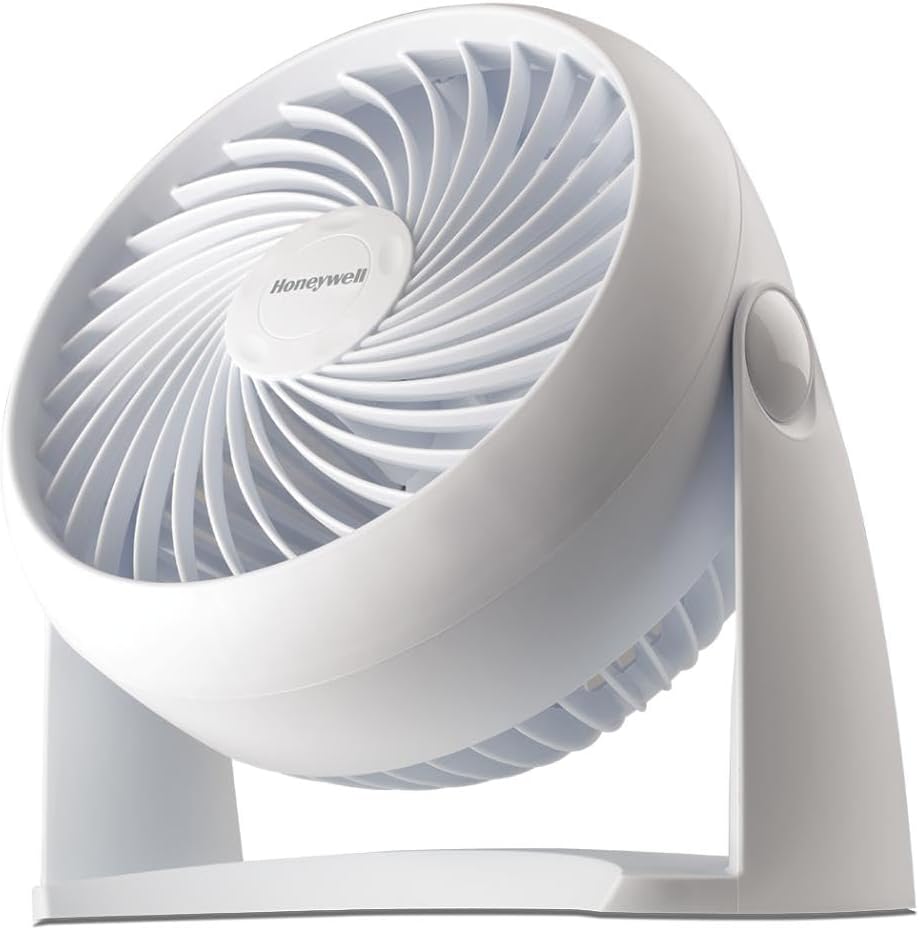
The Honeywell HT-904 has been basically unchanged for a decade, which is unusual in a category where brands compete on spec-sheet features. That staying power tells you something: it works, it's quiet on low, and buyers keep buying it. The review depth here is the most extensive of anything on this list by a wide margin.
On low, buyers consistently describe the aerodynamic TurboForce design as near-silent - a genuine white-noise hum rather than a mechanical buzz. The 90-degree pivot sounds minor until you try pointing it at the ceiling for indirect circulation in a hot room. Several buyers keep multiples in different rooms at this price, which is about as strong an endorsement as you get.
Durability is genuinely mixed. At $15 the math still works even if you replace it every year or two. But buyers who care about longevity should know the variance is real - some units run for years, others fail in months. Set expectations accordingly rather than expecting premium build quality from a $15 fan.
We earn a commission on purchases via these links. It does not change the price you pay or our ranking.
Quiet under $20
Three fans in the 30-35 dB range, all under $25. Real quiet at a price that doesn't require much deliberation.
Best Budget Quiet SWEETFULL 6.5 Inch USB Small Desk Fan
Wood grain finish, 360-degree tilt, legitimately quiet per buyer feedback.
SWEETFULL 6.5 Inch USB Small Desk Fan
Wood grain finish, 360-degree tilt, legitimately quiet per buyer feedback.
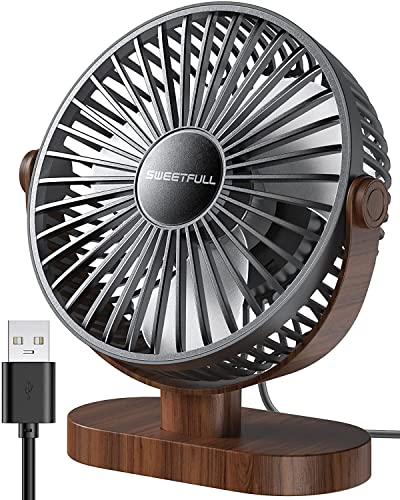
The SWEETFULL's wood grain finish is plastic, not real wood - but it genuinely disappears into home office setups in a way that standard gray USB fans don't. Buyers specifically mention this. It blends with a desk setup rather than reading as a gadget sitting on it.
The 360-degree tilt is more flexible than most competitors in this price range, where you typically get a fixed-angle adjustment. Buyers running it during calls report no background noise complaints from the other end, which is a specific, useful data point. The spec claims under 25 dB; real-world buyer feedback validates it for low-speed operation.
Some units have developed issues after 1-2 months. Not as common as with the cheaper Gaiatop models, but present enough to mention. If you're buying for long-term daily use and price is flexible, the KIMMOO or DREO are safer bets. If $15 and "actually quiet at my desk" is the criteria, this one earns it.
We earn a commission on purchases via these links. It does not change the price you pay or our ranking.
Best Rechargeable Pick KIMMOO Rechargeable USB Desk Fan
100-speed dial-in, 8+ hr battery, USB-C. Fine-grained quiet control.
KIMMOO Rechargeable USB Desk Fan
100-speed dial-in, 8+ hr battery, USB-C. Fine-grained quiet control.
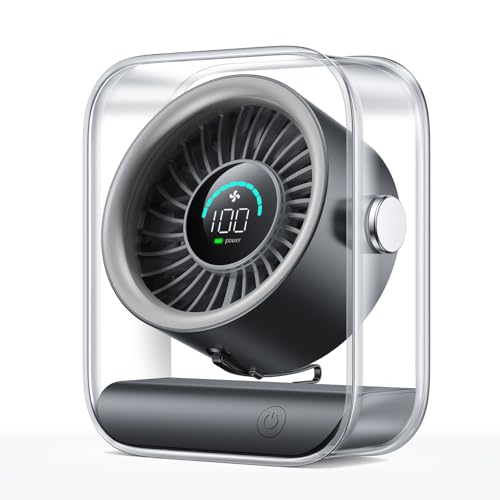
Three speed settings force you to pick between settings that are too quiet (speed 1) and too loud (speed 3) with nothing in between. The KIMMOO solves that problem completely. 100 speed levels means you find the exact airflow you want without sacrificing more quiet than necessary to get it. At speeds 1-10, buyers describe operation as near-silent. That level of control simply doesn't exist on 3-speed fans.
The battery lasts 8+ hours at low settings, which means overnight use without a cord tangled across the nightstand. It also runs plugged in - dead battery shouldn't mean dead fan on a hot day. USB-C charging adds up to 2.5 hours to a full charge, which is fast relative to the battery capacity.
Moderate review volume - this is a newer product and the long-term track record is thinner than the Honeywell models. No significant durability red flags in existing feedback, but a smaller sample. Buy it for the features (battery, 100-speed control, USB-C) while understanding you're getting less field-tested reliability data than the Honeywell.
We earn a commission on purchases via these links. It does not change the price you pay or our ranking.
KONSIDEN Desk Fan Bladeless
Bladeless, child/pet safe, smooth airflow. Power is limited at this price.
KONSIDEN Desk Fan Bladeless
Bladeless, child/pet safe, smooth airflow. Power is limited at this price.
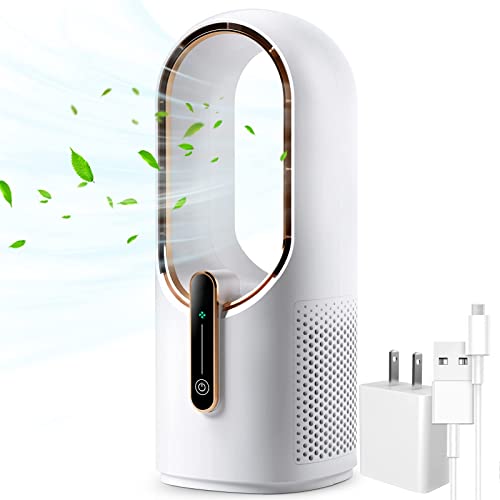
No spinning blades means two things: child and pet safe (the "fingers in the fan" scenario literally can't happen), and a different feel to the airflow. Bladeless fans produce a smoother, less choppy stream than bladed fans at similar dB levels. Buyers who've switched describe the air as more natural - less like standing in front of an industrial fan, more like a steady breeze.
Buyers who run it 24/7 for months report consistent performance. The durability concern that dogs the $8 USB models isn't as present here. The touch control keeps the surface clean and easy to operate with sticky fingers or gloves.
Power is the honest limit. This is a close-proximity personal fan. Pointed at your face from a few feet away at a desk, it does its job well. Expecting it to cool a room is a different use case - one where the DREO handles 60 feet of throw and this one handles maybe 10. At $32, you're paying for the design and the safety benefit, not maximum airflow.
We earn a commission on purchases via these links. It does not change the price you pay or our ranking.
Portable and cheap
USB-powered, palm-sized, under $10. Not whisper-quiet, but genuinely useful for travel, classrooms, and anywhere personal airflow matters more than silence.
Best Budget Portable Gaiatop USB Desk Fan
$8, packs flat, adequate for travel and desk use at the budget ceiling.
Gaiatop USB Desk Fan
$8, packs flat, adequate for travel and desk use at the budget ceiling.
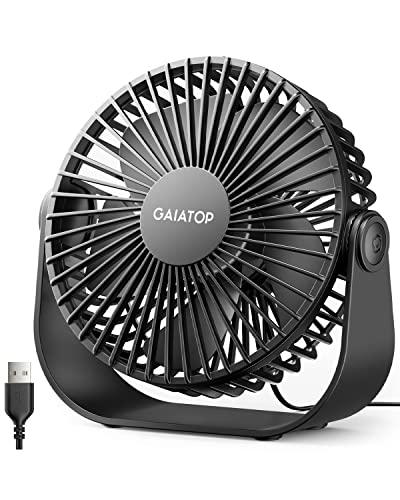
At $8 and 40 dB, this is the best noise-per-dollar product on the list. Not the quietest fan here - but the cheapest one worth buying for anyone with any noise sensitivity at all. The Gaiatop Blue at 50 dB and the same price is measurably louder per spec; this one's the call if you're spending under $10.
Buyers use this fan for travel because it packs flat, runs off a laptop USB port, and the 5-foot cord is long enough to reach wherever you want it on a hotel desk. The rubber base pads keep it from sliding even on polished surfaces. For a classroom teacher who just needs a targeted breeze during a heat wave, or someone working from a bag who needs minimal extra weight, this is the practical answer.
Be clear about what 40 dB means: you'll know the fan is running. It's not intrusive in the way a 50 dB fan is, but this isn't a sleep fan for sensitive sleepers. Low setting is workable overnight for people who aren't particularly noise-sensitive. For the price, most buyers accept that trade-off without complaint.
We earn a commission on purchases via these links. It does not change the price you pay or our ranking.
Gaiatop USB Desk Fan
Cheapest option. 50 dB is audible in a quiet room. Budget travel pick.
Gaiatop USB Desk Fan
Cheapest option. 50 dB is audible in a quiet room. Budget travel pick.
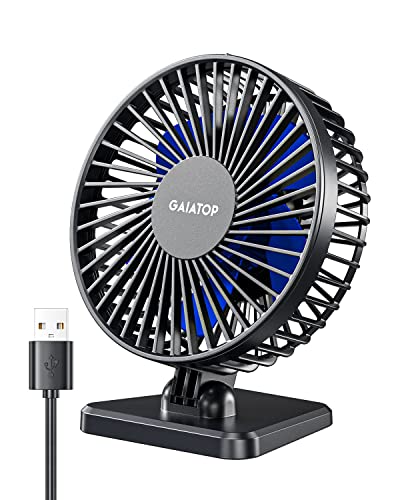
The cheapest option, the most extensively reviewed, and the loudest fan on this list. It earns its place by doing what it says and having enough buyer history to confirm it. At $8 and 50 dB, this is a "I need personal airflow right now" buy - not a "I need quiet" buy.
50 dB is audible in a quiet room. That's not a complaint - it's what the spec says, and buyers who picked this for a silent bedroom were shopping wrong. For a classroom with broken AC, a shared office where ambient noise already exists, or travel where you just want a breeze, the feedback is consistently adequate. It works as described.
One note: if you're choosing between this and the Gaiatop Black (40 dB, same price), the Black is the call. The same money, 10 dB quieter. This one's here because it has the strongest review base in the budget tier and some buyers specifically want the color options.
We earn a commission on purchases via these links. It does not change the price you pay or our ranking.
Oscillating personal fan
The one fan on this list that sweeps rather than blasts. Better for shared spaces or when you want air movement rather than a fixed stream.
Honeywell HTF210B QuietSet Personal Table Fan
Oscillates, 4 speeds, fine for offices. QuietSet branding oversells it.
Honeywell HTF210B QuietSet Personal Table Fan
Oscillates, 4 speeds, fine for offices. QuietSet branding oversells it.
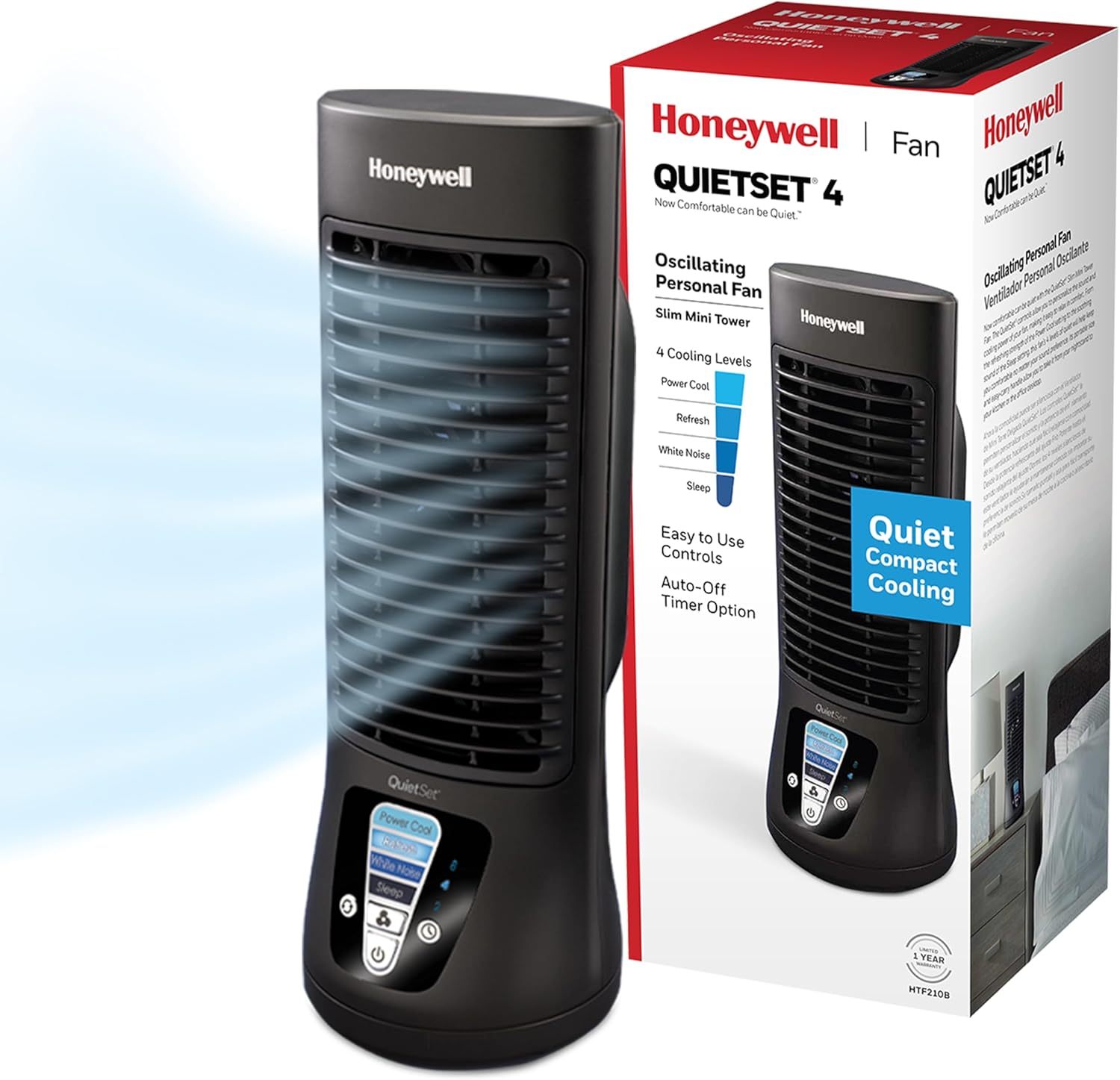
The oscillation is why this fan exists on this page. Every other fan here points in a fixed direction - this one sweeps. If you share an office and don't want to blast a coworker with a constant direct stream, or if you want general air movement in a bedroom without the fan aimed directly at you all night, oscillation solves that. None of the other options do.
Four speed levels give more flexibility than the three-speed USB fans. The lowest "Sleep" setting is real - it does run more quietly than the standard low setting. Office desk users consistently find it moves enough air without blowing papers around, which is a specific, practical win.
The QuietSet branding oversells the noise level. At 45 dB, this is Average on this page's scale - not loud, but clearly audible in a quiet room. Buyers shopping specifically for a quiet fan will find the DREO or HT-904 significantly better. The bright blue LED indicators are a persistent complaint from bedroom users - they're not adjustable without disassembly. At $33, you're close to the DREO at $29, which is quieter and moves more air. The oscillation is the only argument for this one over that.
We earn a commission on purchases via these links. It does not change the price you pay or our ranking.
What actually matters when buying a quiet desk fan
What those dB numbers mean in your room
Manufacturer dB specs are measured at the lowest speed setting in near-ideal conditions. The number on the box is as quiet as the fan ever gets. Real-world noise at your preferred speed will often be 5-15 dB higher. Keep that in mind when comparing specs.
Here's what the range on this page sounds like in practice:
The speed-setting trap
The right question isn't "is this fan quiet?" It's "is this fan quiet at the speed I'll actually use it?" Every fan on this list gets louder as speed increases. The spec is always for low.
A 3-speed fan forces you to choose between too-gentle (speed 1) and noticeable (speed 3). The KIMMOO's 100-speed control is the solution to that problem - you find the exact airflow you want without sacrificing more quiet than necessary. Worth the extra cost if you're genuinely sensitive to fan noise.
USB power vs AC power: what the ceiling means
USB-powered fans run on 5V, which caps their motor size and RPM. That limits both maximum airflow and maximum noise - which is why most USB desk fans max out around 40-50 dB even on high. It also limits how much air they can actually move.
AC-powered fans like the DREO can have significantly larger motors. That's why a well-designed AC circulator can be quieter and move more air than a USB fan half its size. The DREO at 20 dB moves 800 CFM. The USB fans at 40-50 dB move a fraction of that. If your desk has space for an 11-inch fan, the AC option is the better deal on both dimensions.
When the $8 USB fan is and isn't the right answer
It's the right answer when: you need personal airflow at minimal cost, you're traveling and need something that packs flat, you work in a loud environment where background noise already covers the fan sound, or you just need to survive a week without AC.
It's not the right answer when: you're a light sleeper, you're on video calls where the mic will pick up background noise, or you find 40-50 dB fans intrusive in quiet rooms. For those cases, the $15 Honeywell or $29 DREO are worth it.
Bladeless vs bladed: the airflow character difference
Bladeless fans don't necessarily measure quieter than bladed fans. The KONSIDEN at 30 dB is quiet; so is the SWEETFULL bladed fan at 30 dB. The difference is perceptual: bladeless fans produce a smoother, more continuous stream without the slight pulse that spinning blades create. Some buyers find that gentler over long periods, even when the measured dB is the same. If you're sensitive to choppy airflow rather than just loudness, that distinction matters.
Common questions
How quiet is a quiet desk fan?
Under 30 dB is library-level quiet. The DREO at 20 dB and the Honeywell HT-904 at 25 dB on low are described by buyers as near-inaudible - you feel air moving before you hear the fan. The 30-40 dB range is quiet but present. Above 45 dB you'll know the fan is running in a quiet room. Most "quiet" fan claims refer to low-speed operation only.
Are bladeless fans quieter than regular fans?
Not necessarily, by the dB number. Bladeless fans produce smoother, less choppy airflow, which many buyers describe as less fatiguing over long periods. The measured noise level can be identical to a bladed fan at the same setting. If you're bothered by the slight pulse that spinning blades create, bladeless is worth it. If you're purely optimizing for lowest dB, the blade design doesn't matter as much as motor quality.
Which desk fan is quiet enough for sleeping?
The DREO (20 dB) and Honeywell HT-904 (25 dB) are consistently described as sleep-compatible by buyers who use them on nightstands. The SWEETFULL and KONSIDEN at 30 dB are workable for most people. The $8 Gaiatop fans at 40-50 dB are borderline - fine for people who aren't sensitive to background noise, but likely to wake light sleepers.
Which desk fan won't interfere with video calls?
Under 35 dB to avoid audible background fan noise on most mics. The DREO (20 dB), Honeywell HT-904 (25 dB), SWEETFULL (30 dB), KONSIDEN (30 dB), and KIMMOO (35 dB on low) all qualify. The Gaiatop fans at 40-50 dB may be audible on the other end, depending on your mic and room acoustics. When in doubt, test on a call before committing to your desk setup.
Does price predict how quiet a desk fan is?
No, not consistently in this category. The $15 Honeywell HT-904 at 25 dB beats the $33 Honeywell QuietSet at 45 dB on noise. Price tracks features (battery, oscillation, LED display, bladeless design) not noise level. The quietest fan on this list (DREO, 20 dB) costs $29. The loudest (Gaiatop Blue, 50 dB) costs $8. Spend more for features or durability, not necessarily for quiet.