Generators · 2026 edition
Quiet home generators for power outages
Three days after the storm. The power is out, the fridge is warming up, and the gas station two miles away has a line of cars stretching into the street. This is the scenario most generator pages ignore when they list every 2500-watt camping unit that mentions "home use" in the title.
We looked at 30 generators and cut to 8 that actually fit the job: home backup power for outages that last days, not hours. From a $450 dual-fuel essentials unit to a $1,899 whole-home inverter. Wattage math included, because "quiet home generator" without knowing what load you're running is an incomplete answer.
Whole-Home Backup
When a storm takes power for days, you need to run everything. These two handle HVAC, refrigerator, the water heater circuit, and lights simultaneously - the coverage level that means nobody sleeps at a hotel.
Best Whole-Home Value Westinghouse 12500W
Proven on 2700+ sqft homes. The forum default recommendation for good reason.
Westinghouse 12500W
Proven on 2700+ sqft homes. The forum default recommendation for good reason.
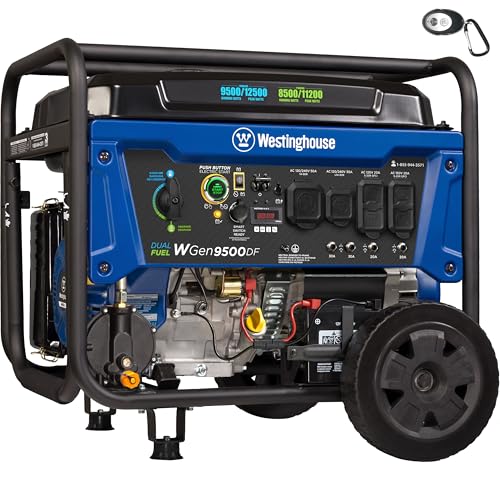
This is the generator that shows up on every hurricane prep forum, every "what did you buy before the storm" Reddit thread, and most emergency management recommendation lists. The reason isn't marketing spend. It's that enough people have run it through enough actual multi-day outages to produce a reliable verdict: it works.
9500 running watts on gas, 8500 on propane. Transfer-switch ready with both L14-30R and 14-50R outlets. Dual fuel. Remote start key fob included. Buyers running 2700 sqft homes report full coverage - HVAC, refrigerator, lights - with room to spare. The setup is plug-and-play once a licensed electrician handles the transfer switch: add oil, connect propane or gas, hit the remote.
The honest caveat: this is an open-frame conventional generator. It is not quiet in the way the inverter models on this page are quiet. No verified dB spec exists for this unit - the open-frame design was optimized for wattage, not acoustics. Position it at the far end of your driveway with exhaust pointed away from the house. Your neighbors will hear it. At $999 for 9500 running watts with this level of buyer validation, that's the tradeoff you're making.
We earn a commission on purchases via these links. It does not change the price you pay or our ranking.
Best Inverter for Whole-Home Westinghouse 11000W Dual Fuel Inverter
Inverter quality at whole-home scale. Remote start and CO sensor standard.
Westinghouse 11000W Dual Fuel Inverter
Inverter quality at whole-home scale. Remote start and CO sensor standard.
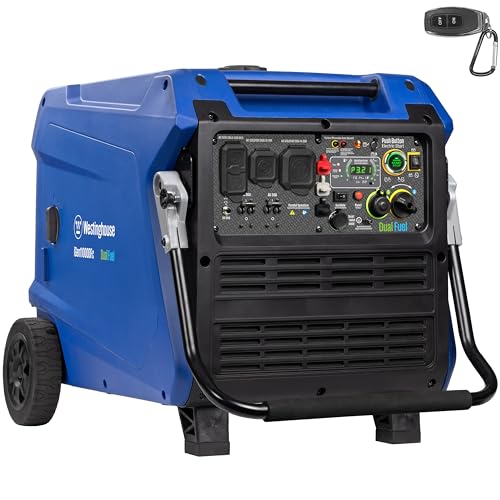
Same Westinghouse brand, fundamentally different machine. The 11000W inverter costs $900 more than the 12500W open-frame - and that gap buys something real.
Inverter technology means the engine varies speed with the load instead of running at constant RPM. At 50% load, it's noticeably quieter than an open-frame equivalent. The LED data center shows fuel level, power output, remaining runtime, voltage, and lifetime hours in real time - you can see exactly what load the generator is carrying, which matters when you're trying to stretch a tank through a third day. The 9.8-gallon tank (gas) runs up to 17 hours at moderate load.
The inverter output also produces clean power - less than 3% THD - which matters for modern homes. Smart thermostats, medical equipment like CPAP machines, inverter appliances, and any device with a switching power supply are sensitive to power quality. The open-frame 12500W is fine for lights and a refrigerator; the 11000W inverter handles everything without risk to electronics.
Buyers confirm propane cold-start worked on first try with the included remote. Transfer-switch-compatible outlets. CO sensor standard. At $1,899 plus transfer switch installation costs, this is a considered purchase - not an impulse buy before a storm.
We earn a commission on purchases via these links. It does not change the price you pay or our ranking.
Mid-Range Backup (5000-9000W)
Enough watts for the essential circuits in most homes under 2,000 sqft. The widest variation in quality lives here - one option has an ATS outlet, one has mixed reliability, one undercuts the competition by $300.
GENMAX 9000W Dual Fuel
Good specs, parallel-capable. Reliability track record shorter than Westinghouse.
GENMAX 9000W Dual Fuel
Good specs, parallel-capable. Reliability track record shorter than Westinghouse.
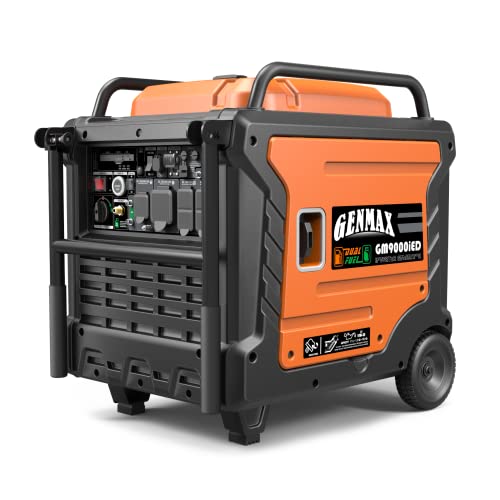
The GENMAX 9000W sits at the same $1,899 price point as the Westinghouse 11000W inverter, with similar specs on paper and a shorter track record.
The parallel capability is the genuine differentiator. Two GM9000iED units connected produce 15,200 running watts and 18,000 peak watts - territory that covers commercial operations, large properties, or off-grid setups with heavy loads. The 62 dBA noise spec (manufacturer-stated at 25% load, 23 feet) is reasonable for this wattage class. CO detect, remote key fob, 6.9 gallon tank, dual fuel.
The reliability picture is mixed. Some buyers report flawless operation from day one. Others report startup issues and dead battery problems on the electric start system. Battery tender as a companion purchase is a reasonable precaution if you buy this unit and plan to store it for months between uses. The Westinghouse 11000W has a larger and more consistent buyer track record at the same price - that's the honest comparison.
We earn a commission on purchases via these links. It does not change the price you pay or our ranking.
GENMAX 7250W
Has an ATS outlet built in. New product with thin buyer data.
GENMAX 7250W
Has an ATS outlet built in. New product with thin buyer data.
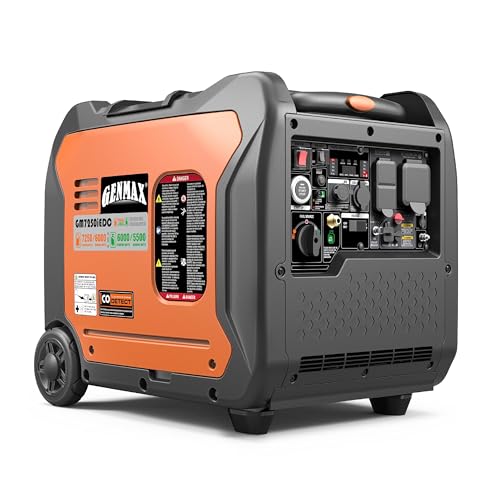
Most generators have a standard L14-30R outlet. The GENMAX 7250W has something different: a dedicated ATS outlet designed to connect to an automatic transfer switch module.
That matters because an ATS gives you near-standby behavior from a portable unit. When the grid goes down, the ATS senses the outage and signals the generator to start, then switches your home circuits over automatically - typically within 30-60 seconds. You still need a licensed electrician to install the ATS module at your panel, and that costs money (typically $500-800 for the module and installation). But the generator itself, at $1,299, is the most affordable entry point into that level of home integration.
The caveat is real: this product was new at the time of this research. The buyer data is thin - a handful of reviews, one of which confirms quiet operation. We cannot assess reliability from this sample. The 3-year warranty is above average for this category. If the ATS feature is specifically what you need, this is worth watching; if you're not planning an ATS installation, the Westinghouse 12500W gives you more watts for $300 less.
We earn a commission on purchases via these links. It does not change the price you pay or our ranking.
Pulsar 7250W Dual Fuel
Cheapest 6000W+ dual-fuel unit here. Reliability reports are mixed.
Pulsar 7250W Dual Fuel
Cheapest 6000W+ dual-fuel unit here. Reliability reports are mixed.
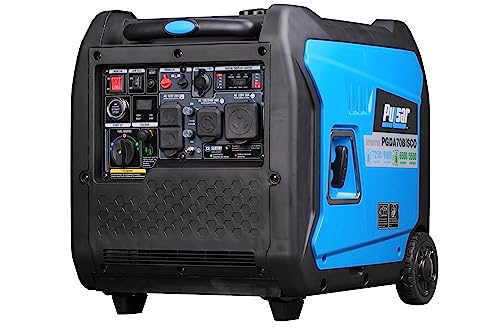
$998 for 6000 running watts and dual fuel. That undercuts every other generator in the mid-range segment by at least $300. The specs are real: 120V and 240V output, USB-A and USB-C, parallel capability, remote start.
The question is what you're giving up at that price. The buyer feedback tells a specific story. Remote start and electric start failures are reported by multiple owners. Handle breakage shows up across different buyers. Reliability is described as mixed - not uniformly bad, but inconsistent enough to flag. These aren't the kinds of problems that surface in a single weekend test. They show up after months.
There's a real scenario where this works: a mild climate, occasional use, and someone who's comfortable troubleshooting a generator if something goes wrong. For a first generator in a region with serious winter storms, or as the primary backup for a house you depend on, the data doesn't support a confident recommendation. The Westinghouse units cost more and have better reliability track records. That gap exists for a reason.
We earn a commission on purchases via these links. It does not change the price you pay or our ranking.
Essential Appliances Coverage (3000-5000W)
Keeps the fridge cold, the lights on, and phones charged. For smaller homes, apartments, or tighter budgets - a right-sized generator for essentials often serves better than overpaying for wattage you'll never pull.
Best Mid-Size Inverter WEN 4800W Inverter
Clean inverter power for home essentials. Solid WEN reliability confirmed by buyers.
WEN 4800W Inverter
Clean inverter power for home essentials. Solid WEN reliability confirmed by buyers.
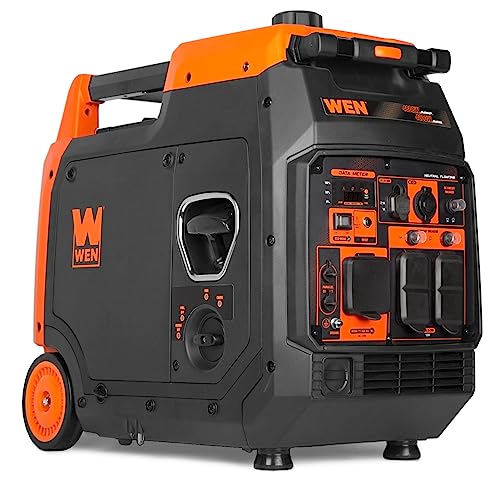
4000 running watts, inverter technology, CO Watchdog. The WEN 4800W (56477i) is the gas-only version of WEN's inverter lineup - simpler than the dual-fuel DF480iX, which covers the RV use case on a separate page.
Buyers running AC and microwave simultaneously confirm it handles the load without complaint. The CO Watchdog sensor gets specific mentions as a differentiator - it auto-shuts the generator when CO levels rise, which matters for the homeowner who forgets it's running outside and closes a garage door. The four 120V outlets plus RV outlet plus 12V DC give you connection flexibility.
At 72.7 lbs, this is not a one-person move once you factor in oil and fuel. Get a hand truck or recruit help. Gas only (no propane fallback) - the simpler fuel system is part of why it's lighter. Buyers report 7.5 hours of runtime on a tank at moderate load. For a home that needs refrigerator, lights, device charging, and one window AC through an overnight outage, that's enough to reach morning.
We earn a commission on purchases via these links. It does not change the price you pay or our ranking.
PowerSmart 3800W Dual Fuel
Dual fuel at $450. The propane option matters when gas lines form after storms.
PowerSmart 3800W Dual Fuel
Dual fuel at $450. The propane option matters when gas lines form after storms.
3300 running watts, dual fuel, $449. The PowerSmart 3800W is the essentials-coverage entry point with the fuel flexibility that home backup specifically demands.
The propane argument matters more here than it does for camping. A hurricane or ice storm that knocks out regional power also creates gas station lines within hours. Propane stored in a 20 lb tank on your property doesn't require leaving the house. That's 8-10 hours of runtime at moderate load - enough to keep the refrigerator cold and phones charged through an overnight stretch without a resupply run.
70 dBA is the manufacturer's stated spec. That's louder than the inverter units on this page - comparable to a vacuum cleaner from across the yard. Not suitable for the side of the house next to a neighbor's bedroom window. Set it back, point the exhaust away, accept the noise tradeoff at this price point. First and second pull starts confirmed by buyers across different weather conditions. Oil change design gets specific positive mentions - small thing, but it matters for a generator you might use twice a year.
Budget Inverter Pick Aceup Energy 4000W Inverter
Budget inverter. Buyers confirm 15,000 BTU AC loads. Tank is small for multi-day use.
Aceup Energy 4000W Inverter
Budget inverter. Buyers confirm 15,000 BTU AC loads. Tank is small for multi-day use.
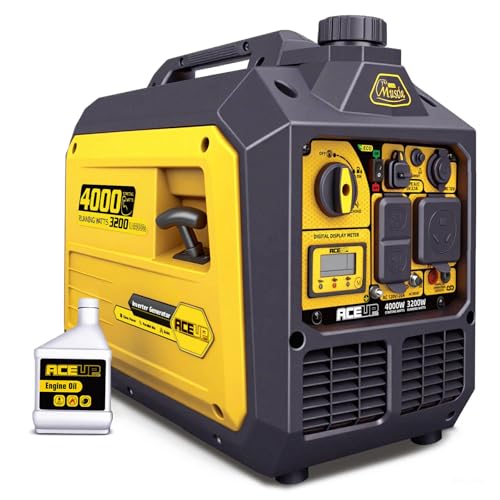
$400 for a 4000W inverter. The Aceup Energy 4000W is the budget entry point for clean-power home backup.
The intelligent gauge - tracking voltage, runtime, fuel level, Hz, and output simultaneously - is unusually capable at this price. Buyers report running it through 15,000 BTU AC loads without problems. The eco mode drops the noise floor to around 60 dBA at light loads (manufacturer spec, 25% load at 23 feet). At real home backup loads, expect somewhat higher.
The 1.32-gallon tank is the limiting factor for extended use. At 50% load, that's roughly 5 hours before refueling. For a one-day outage with short gaps, fine. For a three-day winter storm, you're running to the gas station repeatedly or staging additional fuel storage. The Aceup handles the short-to-medium outage scenario well at its price point; the Westinghouse units are the answer when the outage stretches past a day.
We earn a commission on purchases via these links. It does not change the price you pay or our ranking.
All 8 Picks at a Glance
Every generator on this page. Sorted by wattage class, with noise tier and a one-sentence verdict. The dB column shows manufacturer-stated specs where available - several units have no published spec.
| Product | dB | Type | Price | Badge | Verdict |
|---|---|---|---|---|---|
| Westinghouse 12500 Watt Dual Fuel Home Backup Portable Generator | no spec | Open Frame | $999 | Best Whole-Home Value | Proven on 2700+ sqft homes. The forum default recommendation for good reason. |
| Westinghouse 11000 Peak Watt Dual Fuel Portable Inverter Generator | no spec | Dual Fuel Inverter | $1899 | Best Inverter for Whole-Home | Inverter quality at whole-home scale. Remote start, ATS-compatible outlets. |
| GENMAX Portable Generator | 62 dB | Dual Fuel Inverter | $1900 | Good specs, parallel-capable. Reliability track record is shorter than Westinghouse. | |
| GENMAX Portable Generator | no spec | Dual Fuel Inverter | $1300 | Has an ATS outlet built in. New product with thin buyer data. | |
| Pulsar 7 | no spec | Dual Fuel | $998 | Cheapest 6000W+ dual-fuel option here. Reliability reports are mixed. | |
| WEN Quiet Lightweight 4800 | no spec | Gas Inverter | $635 | Best Mid-Size Inverter | Clean inverter power for home essentials. WEN reliability confirmed by buyers. |
| B0FSD2SJJP | 70 dB | Dual Fuel | - | Dual fuel at $450. The propane option matters when gas lines form after storms. | |
| Aceup Energy 4000 Watt Inverter Generator Portable 149cc | 60 dB | Gas Inverter | $400 | Budget Inverter Pick | Budget inverter. Buyers confirm 15,000 BTU AC loads. Tank is small for multi-day use. |
Buying Guide: What to Know Before You Buy
How much power do you actually need?
The wattage on the box is the generator's capacity, not what you'll use. What matters is the total load you need to run simultaneously - plus the starting surge of the biggest motor in that list.
Common appliance running watts: refrigerator 200-400W, window AC unit (10,000 BTU) 1,000-1,200W, central HVAC (3-ton) 3,000-4,500W, sump pump 750-1,000W, LED lighting per circuit 10-30W, phone and device charging 20-100W total.
Starting watts (also called surge watts) can be 2-3 times the running watts. A refrigerator rated at 200W running draws around 1,000W for the first second it starts. Size the generator for the highest starting surge you'll see, not just the steady state. Add 20-25% headroom. That's your required rated output.
Three scenarios: Essentials only (fridge, lights, device charging, one window AC) - 3,000-4,000W running watts. Comfortable coverage (all essentials plus HVAC fan, not full central AC compressor) - 5,000-7,000W. Whole home (central HVAC in full operation plus all appliances) - 8,000-10,000W+.
What "quiet" means for a home generator
Generator noise specs are measured at 25% load (the unit barely running) at 23 feet in controlled conditions. Real home backup use runs at 50-75% load. Expect 3-8 dB higher than the spec under actual conditions.
What those numbers mean outside your house: 52-58 dBA is audible at a property line but generally not intrusive - most suburban neighbors will accept it. 60-65 dBA is comparable to a busy restaurant from across the yard. 68-75 dBA is louder than a vacuum cleaner and will be audible inside neighboring homes with windows open. Above 75 dBA (open-frame conventional territory) belongs in rural or well-separated settings.
Sound also carries differently at night. A generator that blends into daytime ambient noise becomes more noticeable at 11pm in a quiet neighborhood. Factor in when you'll actually be running it.
Gas vs propane for home backup
This question has a different answer for home backup than for camping. Camping: gas stations are rarely at capacity. Home backup after a regional storm: gas stations often run out within hours of a major outage.
Propane stored on your property doesn't expire (shelf-stable for years with no stabilizer needed), doesn't require leaving the house, and eliminates the fuel-line clogging problems that plague gas generators stored for months between uses. A 20 lb propane tank (the standard BBQ size) runs a 4,000W generator at 50% load for roughly 8-10 hours. A 100 lb tank stretches that to 40-50 hours - enough for a multi-day outage.
Dual-fuel generators are the right answer for serious home backup. Start on gas (always immediately available), run extended periods on propane. The premium over single-fuel equivalents is typically $50-150.
Do you need a transfer switch?
Two approaches, meaningfully different. Running extension cords directly to specific appliances is legal and requires no installation - plug the cord into the generator and the appliance into the cord. The limitation: extension cords only reach portable devices. Your hardwired HVAC, well pump, and built-in lighting circuits are not accessible this way.
To power hardwired home circuits, you need a transfer switch installed at your electrical panel by a licensed electrician. A manual transfer switch (MTS) costs $200-500 for the hardware plus $200-500 in labor. An automatic transfer switch (ATS) costs $300-700 for the hardware plus $500-800 in labor - and senses an outage automatically, switching circuits to generator power without you doing anything.
The GENMAX 7250W on this page has a dedicated ATS outlet built in, which is the connection point for a compatible ATS module. It still requires the licensed electrician installation; it just means the generator hardware is already prepared for it.
One safety point that is not optional: back-feeding the grid by connecting a generator directly to an outlet without a transfer switch is illegal in all US states, can electrocute utility workers restoring power to your street, and voids homeowner's insurance. Don't do it.
Frequently Asked Questions
What size generator do I need for my house?
It depends on what you want to power. For essentials only (refrigerator, lights, device charging, one window AC unit): 3,000-4,000 running watts. For everything plus the HVAC fan (not the full compressor): 5,000-7,000W. For central AC operation and all appliances: 8,000-10,000W or more.
The critical variable is starting watts. Your refrigerator draws roughly 1,000W to start even though it only runs at 200W. Size for the starting surge of your largest motor, not just the steady-state load.
How quiet is a quiet home generator?
The best inverter models reach 52-58 dBA at light loads, roughly comparable to a moderate conversation. At real home backup loads (50-75% capacity), expect 60-68 dBA. At 65 dBA from 23 feet away, you're hearing something like a busy restaurant conversation from across the yard - audible, but not intrusive in most suburban settings.
Manufacturer specs are always measured at 25% load. For honest comparison, add 3-8 dB to any number you see in a spec sheet.
Do I need a transfer switch to connect a generator to my house?
Yes, if you want to power hardwired circuits. Extension cords work for portable appliances but won't reach your HVAC, well pump, or lighting circuits. A licensed electrician must install a transfer switch at your panel - budget $400-1,200 depending on manual vs automatic.
Back-feeding the grid without a transfer switch (plugging the generator into a wall outlet) is illegal in all states and creates electrocution risk for utility workers.
Gas or propane - which is better for home backup power?
Propane for extended outages. Gas goes stale without stabilizer after 30 days, and gas stations run out within hours during regional storms. Propane stored on your property is shelf-stable for years and doesn't require leaving the house. A 100 lb tank runs a 4,000W generator at 50% load for 40+ hours.
Dual-fuel generators give you both options. That's the right answer for anyone treating a generator as real home infrastructure rather than occasional camping gear.